Skip to content
FinTool
The FinTool journal

Better questions.
Clearer money decisions.

Explore practical explanations of saving, borrowing and everyday budgeting. Understand the assumptions behind the numbers.

Latest from the blog

29 articles
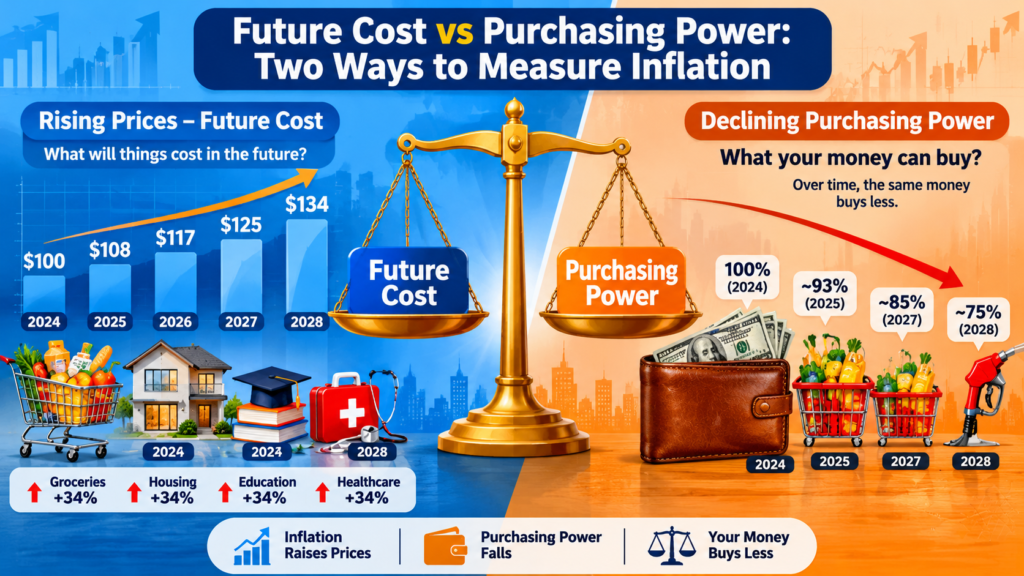
Future Cost vs Purchasing Power: Two Ways to Measure Inflation Inflation can be measured in two useful ways: by looking at how much prices rise over time (future cost) and by examining how much your money can buy (purchasing power). Although both approaches describe the same economic phenomenon, they answer different questions. Future cost tells you what an item may cost years from now, while purchasing power reveals how inflation affects the real value of your income and savings. Understanding both perspectives helps you make better decisions about spending, saving, investing, and long-term financial planning. Understanding Inflation Beyond the Headline Number Most people encounter inflation as a percentage reported in economic news. A statement such as "inflation is 3% this year" seems simple enough, but that figure describes only the rate at which average prices are increasing. The practical impact of inflation becomes clearer when you view it from two angles: Future Cost: How much more money you will need to buy something in the future. Purchasing Power: How much less your current money can buy over time. These perspectives are closely connected, yet they lead to different financial insights. For example, if inflation remains at 3% annually, a product costing $100 today would cost approximately $134 after ten years. At the same time, your $100 would buy significantly less than it does today because its purchasing power would decline. The price increase and the loss of purchasing power are two sides of the same coin. The Future Cost Approach The future cost method focuses on how prices increase over time. It answers a question many consumers and investors ask: "How much will this cost in the future?" This perspective is especially useful when planning for major expenses such as: College tuition Housing Healthcare Retirement Vehicles Long-term business costs How Future Cost Is Calculated Future cost calculations typically use compound inflation. The basic formula is: Future Cost = Present Cost × (1 + Inflation Rate)^Years For example: Current cost: $10,000 Inflation rate: 3% annually Time period: 10 years Calculation: $10,000 × (1.03)^10 ≈ $13,439 In this scenario, an item costing $10,000 today may cost around $13,439 in ten years if inflation averages 3% annually. Why Future Cost Matters Future cost calculations help individuals avoid underestimating future expenses. Consider retirement planning. Many people calculate how much income they need based on today's prices. However, retirement may begin decades later. If monthly expenses are $4,000 today and inflation averages 3% annually, those same expenses could exceed $7,200 per month after twenty years. Without accounting for future costs, retirement savings targets may fall short. Common Applications Future cost analysis is widely used for: Situation Why Future Cost MattersRetirement planning Estimates future living expenses Education savings Projects future tuition costs Business budgeting Forecasts operating expenses Insurance planning Adjusts coverage needs Infrastructure projects Anticipates rising construction costs The future cost method turns abstract inflation rates into tangible dollar amounts. The Purchasing Power Approach While future cost looks forward at prices, purchasing power looks inward at the value of money. It answers a different question: "What can my money actually buy?" Purchasing power refers to the quantity of goods and services a certain amount of money can purchase at a given point in time. When inflation rises, purchasing power falls. A Simple Example Imagine you have $1,000 in cash. If inflation averages 5% annually: Prices rise. Your $1,000 remains $1,000. The amount of goods and services you can buy decreases. After several years, the money still exists, but its real value has declined. This is why financial experts often distinguish between: Nominal value: The number printed on currency. Real value: The purchasing power of that currency. Inflation mainly affects real value. Purchasing Power in Everyday Life Many people notice purchasing power changes before they notice official inflation statistics. Examples include: Grocery budgets covering fewer items. Fuel costs consuming a larger share of income. Restaurant meals becoming more expensive. Rent increasing faster than wages. Savings accounts failing to keep pace with rising prices. These experiences reflect declining purchasing power. How Future Cost and Purchasing Power Are Connected Future cost and purchasing power describe the same inflationary process from opposite directions. Consider this example: Today: Product price: $100 Money available: $100 You can buy the item. Ten years later: Product price: $134 Money available: Still $100 You can no longer buy the item. From the future cost perspective: The item's cost increased from $100 to $134. From the purchasing power perspective: Your $100 lost enough value that it can no longer purchase the item. The economic reality is identical. A Worked Example: Saving for a Child's Education Suppose parents estimate that a university education costs $50,000 today. If educational costs rise by 4% annually, what happens over 18 years? Future cost calculation: $50,000 × (1.04)^18 Result: Approximately $101,290 The projected cost is more than double the current amount. Now consider purchasing power. If the parents simply keep $50,000 in a non-interest-bearing account for eighteen years, its purchasing power relative to education expenses declines dramatically. Although they still possess $50,000 in nominal terms, that amount may cover less than half of the future educational cost. This example illustrates why both measurements matter when planning for long-term goals. The Role of Income Growth One common misconception is that inflation automatically makes people poorer. The answer depends on whether income grows alongside inflation. Scenario 1: Wages Keep Pace Suppose: Inflation: 3% Annual wage growth: 3% Prices rise, but income rises as well. Purchasing power remains relatively stable. Scenario 2: Wages Lag Behind Inflation Suppose: Inflation: 6% Wage growth: 3% Prices rise faster than income. Purchasing power declines. Even though workers earn more nominal dollars, they can afford fewer goods and services. Scenario 3: Wages Exceed Inflation Suppose: Inflation: 2% Wage growth: 5% Income grows faster than prices. Purchasing power improves. People become capable of purchasing more goods and services over time. For households, purchasing power often matters more than nominal salary increases. Inflation's Impact on Savings Inflation can quietly erode savings if returns fail to keep pace with rising prices. Imagine two situations: Keeping Cash at Home You save: $10,000 today Inflation averages 3% Ten years pass Your cash remains $10,000. However, its purchasing power falls significantly. Investing With Moderate Growth You invest: $10,000 Annual return: 5% Inflation: 3% The investment grows faster than inflation. Purchasing power increases because real wealth rises. This example demonstrates why investors focus on real returns, not just nominal returns. A nominal return is the percentage gained before accounting for inflation. A real return reflects the increase in purchasing power after inflation is considered. Why Governments and Economists Track Both Perspectives Economists examine both future costs and purchasing power because each provides different insights. Future Cost Helps Forecast Governments use future cost estimates when planning for: Infrastructure projects Public pensions Healthcare spending Education funding Long-term budgets would be inaccurate without inflation projections. Purchasing Power Reveals Living Standards Purchasing power analysis helps measure: Household financial well-being Wage growth effectiveness Consumer confidence Economic inequality A growing economy means little to consumers if purchasing power continues to decline. Common Inflation Measurement Tools Several tools help estimate inflation's impact. Consumer Price Index (CPI) The Consumer Price Index tracks changes in the cost of a representative basket of goods and services purchased by households. Many countries use CPI as their primary inflation measure. Personal Consumption Expenditures (PCE) Some central banks also monitor Personal Consumption Expenditures inflation because it reflects changing consumer behavior and spending patterns. Inflation Calculators Inflation calculators allow users to: Estimate future costs. Compare historical prices. Measure purchasing power losses. These tools are valuable for educational purposes and financial planning, though their projections depend on assumptions about future inflation rates. Common Mistakes When Thinking About Inflation Focusing Only on Rising Prices Many people notice higher prices but ignore changes in income. Real financial health depends on the relationship between earnings and inflation. Assuming Inflation Is Constant Inflation rates fluctuate over time. Long-term financial plans should consider multiple scenarios rather than relying on a single estimate. Ignoring Inflation in Savings Goals A future savings target should reflect projected costs, not today's prices. This mistake can create major shortfalls. Confusing Nominal and Real Returns Investment performance should be evaluated after accounting for inflation. A portfolio returning 6% during a period of 5% inflation provides only about 1% real growth. Using Short-Term Trends for Long-Term Planning Inflation often varies from year to year. Long-term plans benefit from realistic assumptions rather than reacting to temporary spikes or declines. Which Measurement Is More Important? Neither approach is inherently better. The most useful measure depends on the question being asked. Question Better MeasureHow much will this cost in 20 years? Future Cost Is my income keeping up with inflation? Purchasing Power How much should I save for retirement? Both Are investments preserving value? Purchasing Power What will college cost in the future? Future Cost Has my standard of living improved? Purchasing Power Financial planning often requires both perspectives simultaneously. Future cost estimates tell you how much money you will need. Purchasing power analysis tells you whether your income, savings, and investments are keeping pace with inflation. FAQs What is the difference between future cost and purchasing power? Future cost measures how much prices may rise over time. Purchasing power measures how much goods and services a given amount of money can buy. Does higher inflation always reduce purchasing power? Not necessarily. If wages, business income, or investment returns grow faster than inflation, purchasing power can still increase. Why do retirement plans use future cost projections? Retirement may occur decades in the future. Planning based on current prices alone could underestimate future living expenses. Can investments protect against inflation? Some investments may help preserve or increase purchasing power over time, especially when returns exceed inflation. However, all investments carry risks, and outcomes are not guaranteed. Why does money lose purchasing power? Money loses purchasing power when the prices of goods and services rise faster than the value of the money itself. The Bottom Line Future cost and purchasing power are two complementary ways of understanding inflation. Future cost shows how much more expensive goods and services may become over time, while purchasing power reveals how inflation affects the real value of your income, cash, and savings. Looking at only one side can create an incomplete picture. Whether you're planning for retirement, saving for education, managing a household budget, or evaluating investments, combining both perspectives provides a clearer view of inflation's true impact and helps you make more informed financial decisions.
Blog

Future Cost vs Purchasing Power: Two Ways to Measure Inflation

Inflation can be measured in two useful ways: by looking at how much prices rise over time (future cost) and by examining how much your money can buy (purchasing power).…

9 min read
Read article →
Blog

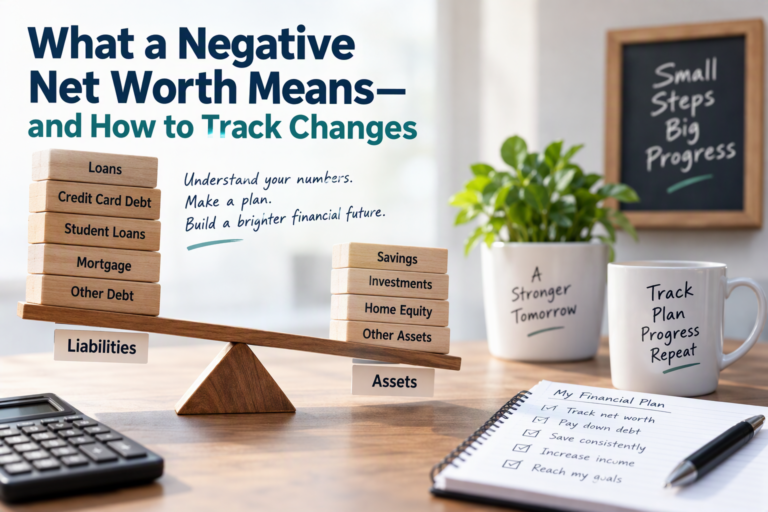
Negative Net Worth: The Hidden Financial Warning Sign You Shouldn’t Ignore

A negative net worth means you owe more than you own. In simple terms, your liabilities, such as loans, credit card balances, and other debts, exceed the value of your…

8 min read
Read article →
How to Find an Annual Simple Interest Rate from Two Amounts
Blog

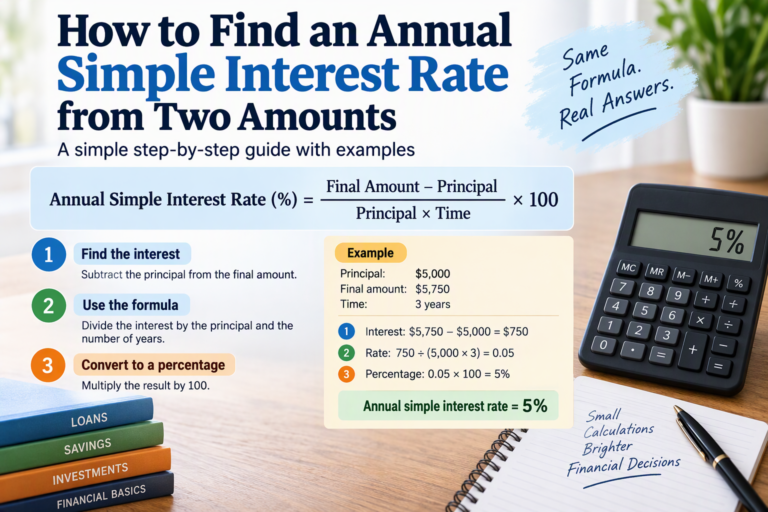
How to Find an Annual Simple Interest Rate from Two Amounts

If you know the starting amount (principal), the ending amount, and the time period, you can find the annual simple interest rate using a straightforward formula: Annual Simple Interest Rate…

6 min read
Read article →
Saving a Lump Sum vs Saving Every Month
Blog

Saving a Lump Sum vs Saving Every Month: A Worked Comparison

If you have money available to save or invest, the question often comes down to timing: should you invest a large lump sum all at once, or save and invest…

8 min read
Read article →
Person calculating annual expenses and converting them into a monthly budget using a calculator and financial spreadsheet.
Blog

How to Turn Annual Expenses into a Monthly Budget

Many expenses do not arrive every month. Property taxes, insurance premiums, holiday spending, school fees, annual subscriptions, and vehicle registration costs often appear once or twice a year. The simplest…

7 min read
Read article →
Debt Payment Must Cover More Than Interest
Blog

Why Your Debt Payment Must Cover More Than Interest

If your debt payment only covers interest, your balance never goes down. You may stay current on payments, but you are not actually reducing what you owe. To eliminate debt,…

8 min read
Read article →
Extra Monthly Payments
Blog

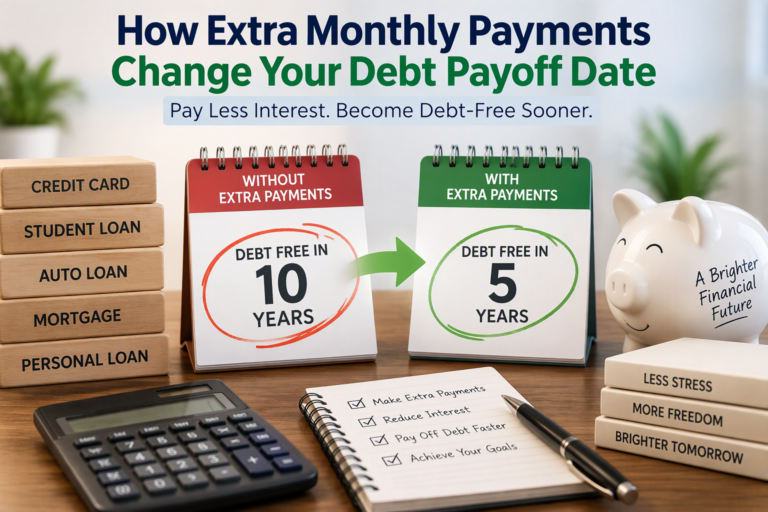
How Extra Monthly Payments Change Your Debt Payoff Date

If you want to get out of debt faster, making extra monthly payments is one of the most effective strategies available. Even small additional payments can significantly reduce your payoff…

8 min read
Read article →
What Happens to Your Loan Payment When Interest Is Zero?
Blog

What Happens to Your Loan Payment When Interest Is Zero?

If the interest rate on a loan is 0%, every payment you make goes directly toward repaying the amount you borrowed. There are no interest charges added to the balance,…

8 min read
Read article →
How Loan Tenure Changes Monthly Payments and Total Interest When you take out a loan, one of the most important decisions is choosing the loan tenure, also known as the repayment period. Loan tenure directly affects two things: how much you pay each month and how much interest you pay over the life of the loan. In simple terms, a longer tenure reduces your monthly payment but increases total interest costs, while a shorter tenure raises monthly payments but saves money on interest. Understanding this relationship can help you choose a repayment period that fits your budget without paying more than necessary. What Is Loan Tenure? Loan tenure is the duration you are given to repay a loan. It is usually expressed in months or years. For example: A car loan may have a tenure of 3 to 7 years. A personal loan may range from 1 to 5 years. A mortgage can extend from 15 to 30 years or even longer in some countries. The lender calculates your Equated Monthly Installment (EMI) or monthly payment based on three main factors: Loan amount Interest rate Loan tenure Changing any of these variables changes your monthly payment and overall borrowing cost. The Basic Relationship Between Tenure and Monthly Payments The connection is straightforward: Longer loan tenure = Lower monthly payments Shorter loan tenure = Higher monthly payments This happens because the borrowed amount is spread across more repayment periods. Imagine borrowing $20,000 at the same interest rate. Short Tenure Loan amount: $20,000 Tenure: 3 years The repayment amount is divided into 36 monthly payments. Long Tenure Loan amount: $20,000 Tenure: 6 years The repayment amount is divided into 72 monthly payments. Since you have more time to repay the loan, each payment becomes smaller. However, there's an important trade-off: interest continues accumulating for a longer period. How Longer Tenures Increase Total Interest Many borrowers focus only on monthly affordability. While lower monthly payments can be appealing, extending a loan often increases the total interest paid significantly. Interest is generally charged over time. The longer you owe money, the longer interest can accrue. Let's use a simplified example. Loan Amount Interest Rate Tenure Monthly Payment Total Interest$20,000 8% 3 Years Higher Lower $20,000 8% 6 Years Lower Much Higher Although the 6-year loan feels easier on your monthly budget, you remain in debt twice as long, giving the lender more time to collect interest. You can verify these differences quickly with a loan calculator such as the tools available on FinTool Bond, which allows borrowers to compare repayment scenarios before committing to a loan. A Detailed Example Let's compare two repayment options for a hypothetical $50,000 loan with an annual interest rate of 7%. Option A: 5-Year Loan Loan amount: $50,000 Interest rate: 7% Tenure: 5 years Monthly payments will be relatively high, but the loan will be paid off quickly. Option B: 10-Year Loan Loan amount: $50,000 Interest rate: 7% Tenure: 10 years Monthly payments become significantly lower, making budgeting easier. However, the borrower pays interest over twice the number of years. As a result: Monthly financial pressure decreases. Total borrowing cost increases. Debt remains outstanding longer. This illustrates the central loan repayment trade-off every borrower faces. Why Lenders Offer Longer Tenures Lenders often provide flexible repayment periods because different borrowers have different financial situations. Longer tenures can help people: Qualify for larger loans. Buy more expensive homes. Manage limited monthly cash flow. Avoid payment stress. For example, many homebuyers choose longer mortgage terms because the property price would otherwise create unaffordable monthly obligations. However, affordability should not be confused with cost efficiency. A loan that is easier to manage each month may ultimately cost much more over its lifetime. Benefits of Choosing a Longer Loan Tenure Longer repayment periods are not always a bad choice. In certain situations, they offer meaningful advantages. Lower Monthly Payments This is the biggest benefit. Smaller payments can make a loan fit comfortably within a household budget and reduce financial pressure. Better Cash Flow When monthly obligations are lower, borrowers have more money available for: Emergency savings Household expenses Investments Education costs Business opportunities Greater Financial Flexibility Unexpected expenses can arise at any time. A lower monthly payment may leave room to handle: Medical emergencies Vehicle repairs Temporary income loss Increased Loan Eligibility Some borrowers only qualify for financing because a longer repayment period keeps their debt-to-income ratio within acceptable limits. Drawbacks of Choosing a Longer Loan Tenure Despite lower monthly payments, longer terms have several disadvantages. Higher Total Interest Costs This is the biggest drawback. Even a small extension in repayment time can result in thousands of dollars in additional interest. Longer Debt Obligation You remain financially committed for more years. This can affect future financial goals such as: Purchasing another property Starting a business Retirement planning Building wealth Slower Equity Growth For mortgages, a larger portion of early payments goes toward interest rather than principal. This means ownership equity grows more slowly. Risk of Financial Changes The longer a loan lasts, the greater the chance of experiencing: Job changes Economic downturns Health challenges Unexpected expenses Long-term debt increases exposure to these risks. Benefits of Choosing a Shorter Loan Tenure Shorter repayment periods can offer substantial savings. Lower Total Interest A greater portion of each payment reduces the principal balance quickly. Because the loan balance falls faster, less interest accumulates. Faster Debt Freedom Paying off debt earlier creates greater financial flexibility and peace of mind. Improved Long-Term Financial Health Without ongoing loan payments, borrowers can redirect money toward: Investments Retirement accounts Emergency funds Education savings Easier Wealth Building Money not spent on interest can be used to grow assets instead. Over time, this difference can have a significant impact on personal finances. Drawbacks of Shorter Loan Tenures Short repayment periods are not suitable for everyone. Higher Monthly Payments This is the most obvious challenge. Monthly payments may exceed what some borrowers can comfortably afford. Reduced Cash Flow More income goes toward debt repayment, leaving less available for other goals. Greater Financial Pressure Unexpected expenses can be harder to manage when loan payments already consume a large portion of monthly income. This is why selecting the shortest possible tenure is not always the smartest financial decision. How to Choose the Right Loan Tenure The ideal loan tenure balances affordability and total cost. Ask yourself these questions: Can I Comfortably Afford the Monthly Payment? Never choose a repayment period that stretches your budget to the limit. You should still have room for: Savings Emergency expenses Insurance Daily living costs How Much Interest Am I Willing to Pay? Compare multiple financing options before signing. A loan calculator can show exactly how much additional interest results from extending the repayment period. Do I Have Stable Income? People with predictable income may comfortably manage shorter payment schedules. Those with variable income often prefer longer terms for flexibility. What Are My Future Financial Goals? Think beyond today's payment amount. Consider whether the loan will affect future plans such as: Home ownership Business investments Children's education Retirement savings A Practical Strategy Many Borrowers Use Some borrowers choose a longer tenure to maintain manageable payments while making extra principal payments whenever possible. This approach offers two advantages: Lower required monthly payment. Opportunity to reduce interest through voluntary prepayments. Before using this strategy, check whether your lender charges: Prepayment fees Early repayment penalties Extra processing charges If no penalties apply, occasional extra payments can shorten the effective loan term and reduce overall interest costs. Common Loan Tenure Mistakes Focusing Only on Monthly Payments Many borrowers select the lowest monthly payment available without considering total loan cost. Always evaluate both affordability and lifetime interest. Ignoring Total Interest A loan with a lower payment is not necessarily cheaper. The total amount repaid matters just as much as the monthly obligation. Borrowing More Than Necessary Long repayment periods sometimes encourage larger loan amounts. Borrow only what you genuinely need. Not Comparing Scenarios Before accepting a loan offer, compare multiple tenure options. Financial calculators make this process simple and can reveal substantial long-term savings. For example, using online calculators like those available at FinTool Bond can help borrowers visualize how changing the loan term affects both monthly payments and overall interest costs. Quick Comparison: Short vs Long Loan Tenure Factor Short Tenure Long TenureMonthly Payment Higher Lower Total Interest Lower Higher Debt-Free Sooner Yes No Cash Flow Flexibility Lower Higher Overall Loan Cost Lower Higher Financial Risk Period Shorter Longer FAQs Does a longer loan tenure always reduce monthly payments? Generally, yes. Spreading repayment over more months lowers the required monthly payment, assuming the loan amount and interest rate remain unchanged. Why does total interest increase with longer tenure? Interest is charged over time. The longer the repayment period, the more opportunities there are for interest to accumulate. Is a shorter loan tenure always better? Not necessarily. While it usually reduces total interest, the higher monthly payment may create financial strain if it exceeds your budget. Can I shorten my loan tenure later? In many cases, yes. Making additional principal payments or refinancing may help reduce the repayment period. Terms vary by lender. How can I compare different loan terms? A loan calculator is often the fastest way to compare repayment scenarios. You can calculate estimated monthly payments and total interest under different tenures before making a borrowing decision. Final Thoughts Loan tenure has a powerful impact on both your monthly payment and the total amount you repay. A longer term can make payments more affordable and improve short-term cash flow, but it usually increases total interest costs. A shorter term can save substantial money over time, although it requires larger monthly payments. The best choice is rarely the shortest or longest option available. Instead, it is the tenure that balances affordability, financial stability, and long-term cost. Before taking any loan, compare multiple repayment periods, calculate the total interest, and understand the trade-offs. A few minutes of planning can save years of unnecessary debt and significant interest expenses.
Blog

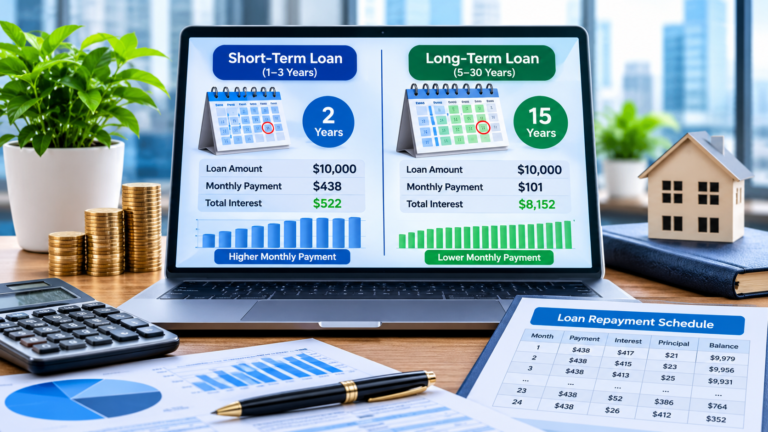
How Loan Tenure Changes Monthly Payments and Total Interest

When you take out a loan, one of the most important decisions is choosing the loan tenure, also known as the repayment period. Loan tenure directly affects two things: how…

9 min read
Read article →