How Loan Tenure Changes Monthly Payments and Total Interest
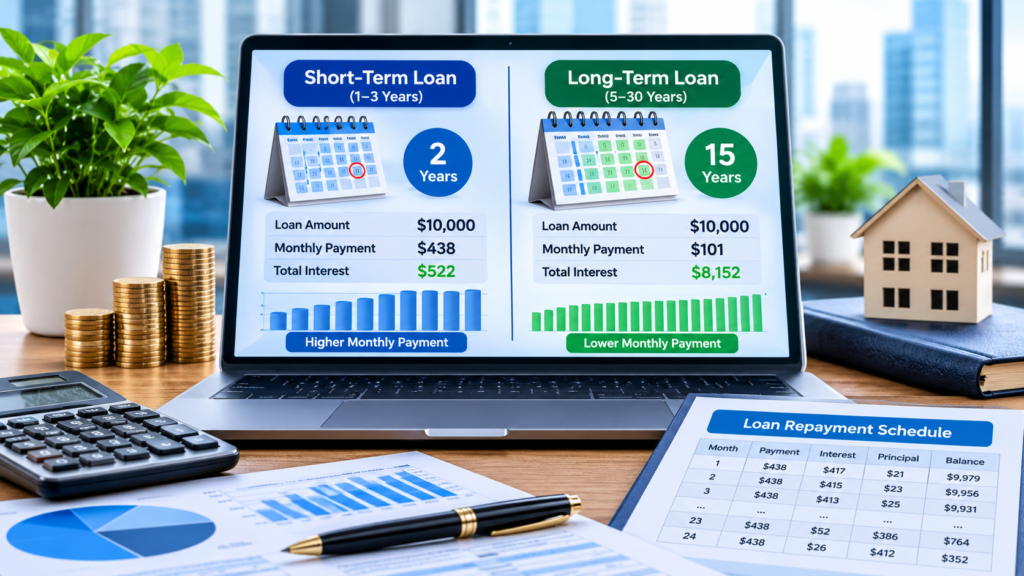
When you take out a loan, one of the most important decisions is choosing the loan tenure, also known as the repayment period. Loan tenure directly affects two things: how much you pay each month and how much interest you pay over the life of the loan. In simple terms, a longer tenure reduces your monthly payment but increases total interest costs, while a shorter tenure raises monthly payments but saves money on interest.
Understanding this relationship can help you choose a repayment period that fits your budget without paying more than necessary.
What Is Loan Tenure?
Loan tenure is the duration you are given to repay a loan. It is usually expressed in months or years.
For example:
- A car loan may have a tenure of 3 to 7 years.
- A personal loan may range from 1 to 5 years.
- A mortgage can extend from 15 to 30 years or even longer in some countries.
The lender calculates your Equated Monthly Installment (EMI) or monthly payment based on three main factors:
- Loan amount
- Interest rate
- Loan tenure
Changing any of these variables changes your monthly payment and overall borrowing cost.
The Basic Relationship Between Tenure and Monthly Payments
The connection is straightforward:
- Longer loan tenure = Lower monthly payments
- Shorter loan tenure = Higher monthly payments
This happens because the borrowed amount is spread across more repayment periods.
Imagine borrowing $20,000 at the same interest rate.
Short Tenure
- Loan amount: $20,000
- Tenure: 3 years
The repayment amount is divided into 36 monthly payments.
Long Tenure
- Loan amount: $20,000
- Tenure: 6 years
The repayment amount is divided into 72 monthly payments.
Since you have more time to repay the loan, each payment becomes smaller. However, there’s an important trade-off: interest continues accumulating for a longer period.
How Longer Tenures Increase Total Interest
Many borrowers focus only on monthly affordability. While lower monthly payments can be appealing, extending a loan often increases the total interest paid significantly.
Interest is generally charged over time. The longer you owe money, the longer interest can accrue.
Let’s use a simplified example.
| Loan Amount | Interest Rate | Tenure | Monthly Payment | Total Interest |
|---|---|---|---|---|
| $20,000 | 8% | 3 Years | Higher | Lower |
| $20,000 | 8% | 6 Years | Lower | Much Higher |
Although the 6-year loan feels easier on your monthly budget, you remain in debt twice as long, giving the lender more time to collect interest.
You can verify these differences quickly with a loan calculator such as the tools available on FinTool Bond, which allows borrowers to compare repayment scenarios before committing to a loan.
A Detailed Example
Let’s compare two repayment options for a hypothetical $50,000 loan with an annual interest rate of 7%.
Option A: 5-Year Loan
- Loan amount: $50,000
- Interest rate: 7%
- Tenure: 5 years
Monthly payments will be relatively high, but the loan will be paid off quickly.
Option B: 10-Year Loan
- Loan amount: $50,000
- Interest rate: 7%
- Tenure: 10 years
Monthly payments become significantly lower, making budgeting easier. However, the borrower pays interest over twice the number of years.
As a result:
- Monthly financial pressure decreases.
- Total borrowing cost increases.
- Debt remains outstanding longer.
This illustrates the central loan repayment trade-off every borrower faces.
Why Lenders Offer Longer Tenures
Lenders often provide flexible repayment periods because different borrowers have different financial situations.
Longer tenures can help people:
- Qualify for larger loans.
- Buy more expensive homes.
- Manage limited monthly cash flow.
- Avoid payment stress.
For example, many home-buyers choose longer mortgage terms because the property price would otherwise create unaffordable monthly obligations.
However, affordability should not be confused with cost efficiency.
A loan that is easier to manage each month may ultimately cost much more over its lifetime.
Benefits of Choosing a Longer Loan Tenure
Longer repayment periods are not always a bad choice. In certain situations, they offer meaningful advantages.
Lower Monthly Payments
This is the biggest benefit.
Smaller payments can make a loan fit comfortably within a household budget and reduce financial pressure.
Better Cash Flow
When monthly obligations are lower, borrowers have more money available for:
- Emergency savings
- Household expenses
- Investments
- Education costs
- Business opportunities
Greater Financial Flexibility
Unexpected expenses can arise at any time. A lower monthly payment may leave room to handle:
- Medical emergencies
- Vehicle repairs
- Temporary income loss
Increased Loan Eligibility
Some borrowers only qualify for financing because a longer repayment period keeps their debt-to-income ratio within acceptable limits.
Drawbacks of Choosing a Longer Loan Tenure
Despite lower monthly payments, longer terms have several disadvantages.
Higher Total Interest Costs
This is the biggest drawback.
Even a small extension in repayment time can result in thousands of dollars in additional interest.
Longer Debt Obligation
You remain financially committed for more years.
This can affect future financial goals such as:
- Purchasing another property
- Starting a business
- Retirement planning
- Building wealth
Slower Equity Growth
For mortgages, a larger portion of early payments goes toward interest rather than principal.
This means ownership equity grows more slowly.
Risk of Financial Changes
The longer a loan lasts, the greater the chance of experiencing:
- Job changes
- Economic downturns
- Health challenges
- Unexpected expenses
Long-term debt increases exposure to these risks.
Benefits of Choosing a Shorter Loan Tenure
Shorter repayment periods can offer substantial savings.
Lower Total Interest
A greater portion of each payment reduces the principal balance quickly.
Because the loan balance falls faster, less interest accumulates.
Faster Debt Freedom
Paying off debt earlier creates greater financial flexibility and peace of mind.
Improved Long-Term Financial Health
Without ongoing loan payments, borrowers can redirect money toward:
- Investments
- Retirement accounts
- Emergency funds
- Education savings
Easier Wealth Building
Money not spent on interest can be used to grow assets instead.
Over time, this difference can have a significant impact on personal finances.
Drawbacks of Shorter Loan Tenures
Short repayment periods are not suitable for everyone.
Higher Monthly Payments
This is the most obvious challenge.
Monthly payments may exceed what some borrowers can comfortably afford.
Reduced Cash Flow
More income goes toward debt repayment, leaving less available for other goals.
Greater Financial Pressure
Unexpected expenses can be harder to manage when loan payments already consume a large portion of monthly income.
This is why selecting the shortest possible tenure is not always the smartest financial decision.
How to Choose the Right Loan Tenure
The ideal loan tenure balances affordability and total cost.
Ask yourself these questions:
Can I Comfortably Afford the Monthly Payment?
Never choose a repayment period that stretches your budget to the limit.
You should still have room for:
- Savings
- Emergency expenses
- Insurance
- Daily living costs
How Much Interest Am I Willing to Pay?
Compare multiple financing options before signing.
A loan calculator can show exactly how much additional interest results from extending the repayment period.
Do I Have Stable Income?
People with predictable income may comfortably manage shorter payment schedules.
Those with variable income often prefer longer terms for flexibility.
What Are My Future Financial Goals?
Think beyond today’s payment amount.
Consider whether the loan will affect future plans such as:
- Home ownership
- Business investments
- Children’s education
- Retirement savings
A Practical Strategy Many Borrowers Use
Some borrowers choose a longer tenure to maintain manageable payments while making extra principal payments whenever possible.
This approach offers two advantages:
- Lower required monthly payment.
- Opportunity to reduce interest through voluntary prepayments.
Before using this strategy, check whether your lender charges:
- Prepayment fees
- Early repayment penalties
- Extra processing charges
If no penalties apply, occasional extra payments can shorten the effective loan term and reduce overall interest costs.
Common Loan Tenure Mistakes
Focusing Only on Monthly Payments
Many borrowers select the lowest monthly payment available without considering total loan cost.
Always evaluate both affordability and lifetime interest.
Ignoring Total Interest
A loan with a lower payment is not necessarily cheaper.
The total amount repaid matters just as much as the monthly obligation.
Borrowing More Than Necessary
Long repayment periods sometimes encourage larger loan amounts.
Borrow only what you genuinely need.
Not Comparing Scenarios
Before accepting a loan offer, compare multiple tenure options.
Financial calculators make this process simple and can reveal substantial long-term savings.
For example, using online calculators like those available at FinTool Bond can help borrowers visualize how changing the loan term affects both monthly payments and overall interest costs.
Quick Comparison: Short vs Long Loan Tenure
| Factor | Short Tenure | Long Tenure |
|---|---|---|
| Monthly Payment | Higher | Lower |
| Total Interest | Lower | Higher |
| Debt-Free Sooner | Yes | No |
| Cash Flow Flexibility | Lower | Higher |
| Overall Loan Cost | Lower | Higher |
| Financial Risk Period | Shorter | Longer |
FAQs
Does a longer loan tenure always reduce monthly payments?
Generally, yes. Spreading repayment over more months lowers the required monthly payment, assuming the loan amount and interest rate remain unchanged.
Why does total interest increase with longer tenure?
Interest is charged over time. The longer the repayment period, the more opportunities there are for interest to accumulate.
Is a shorter loan tenure always better?
Not necessarily. While it usually reduces total interest, the higher monthly payment may create financial strain if it exceeds your budget.
Can I shorten my loan tenure later?
In many cases, yes. Making additional principal payments or refinancing may help reduce the repayment period. Terms vary by lender.
How can I compare different loan terms?
A loan calculator is often the fastest way to compare repayment scenarios. You can calculate estimated monthly payments and total interest under different tenures before making a borrowing decision.
Final Thoughts
Loan tenure has a powerful impact on both your monthly payment and the total amount you repay. A longer term can make payments more affordable and improve short-term cash flow, but it usually increases total interest costs. A shorter term can save substantial money over time, although it requires larger monthly payments.
The best choice is rarely the shortest or longest option available. Instead, it is the tenure that balances affordability, financial stability, and long-term cost. Before taking any loan, compare multiple repayment periods, calculate the total interest, and understand the trade-offs. A few minutes of planning can save years of unnecessary debt and significant interest expenses.