How Extra Monthly Payments Change Your Debt Payoff Date
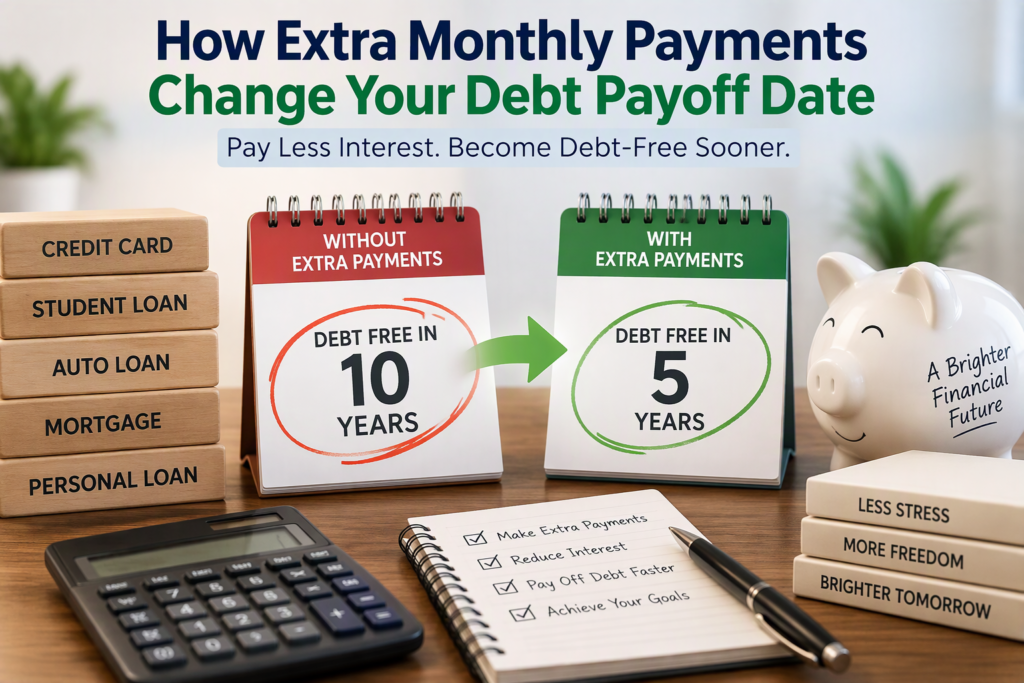
If you want to get out of debt faster, making extra monthly payments is one of the most effective strategies available. Even small additional payments can significantly reduce your payoff timeline, lower the total interest you pay, and help you achieve financial freedom sooner. The reason is simple: extra payments reduce your principal balance faster, which means less interest accrues over time.
Whether you’re paying off a mortgage, auto loan, student loan, or personal loan, understanding how extra payments affect your debt can help you build a smarter repayment plan and save money in the long run.
Why Extra Payments Make Such a Big Difference
Most loans charge interest based on your remaining principal balance. When you make only the required payment, a portion goes toward interest and the rest reduces your balance.
When you pay extra, that additional amount usually goes directly toward the principal. As a result:
- Your loan balance decreases faster.
- Future interest charges become smaller.
- More of each future payment goes toward the principal.
- Your debt payoff date moves closer.
This creates a compounding effect that accelerates your progress month after month.
Understanding the Relationship Between Principal and Interest
To see why extra payments matter, it’s important to understand how loan amortization works.
With most installment loans:
- The lender calculates interest on your remaining balance.
- Your monthly payment covers interest first.
- The remaining amount reduces principal.
- The process repeats every month.
During the early stages of a loan, a larger share of your payment often goes toward interest. Extra payments disrupt this pattern by reducing the balance more quickly.
For example, if you owe $20,000 at a 7% interest rate, every dollar you pay beyond the minimum reduces future interest charges.
A Simple Example
Let’s assume the following loan:
| Loan Details | Amount |
|---|---|
| Original Balance | $15,000 |
| Interest Rate | 8% |
| Monthly Payment | $304 |
| Loan Term | 60 Months |
Under normal circumstances, the loan would be paid off in approximately five years.
Now imagine adding an extra $50 per month.
| Scenario | Estimated Payoff Time |
|---|---|
| Minimum Payments Only | 60 Months |
| Extra $50 Monthly | About 49 Months |
That’s roughly 11 months removed from the repayment schedule.
You also save a meaningful amount in interest because the balance declines faster.
The Higher the Interest Rate, the Greater the Impact
Extra payments are especially powerful on high-interest debt.
Consider these common debt types:
| Debt Type | Typical Interest Impact |
|---|---|
| Credit Cards | Very High |
| Personal Loans | Moderate to High |
| Auto Loans | Moderate |
| Student Loans | Varies |
| Mortgages | Moderate Over Long Terms |
A credit card charging 20% interest can consume a large portion of your payment every month. Applying extra funds toward that balance may save considerably more interest than making the same extra payment on a low-interest loan.
This is why many financial experts recommend targeting high-interest debt first.
How Much Faster Can You Become Debt-Free?
The answer depends on:
- Current balance
- Interest rate
- Remaining loan term
- Monthly payment amount
- Extra payment amount
Even modest changes can produce impressive results.
Example: Extra $25 Monthly
A small additional payment may reduce the payoff period by several months while lowering interest costs.
Example: Extra $100 Monthly
A larger extra payment often cuts years off longer loans and significantly reduces total borrowing costs.
Example: One Additional Payment Per Year
Instead of paying extra every month, some borrowers make one additional full payment annually. This strategy can have a substantial impact, especially on mortgages and long-term loans.
Using a debt payoff calculator can help you estimate exact savings based on your loan details. Tools like those available on FinTool Bond can simplify these calculations and help you visualize different repayment scenarios.
Benefits Beyond Interest Savings
While saving on interest is important, faster debt repayment offers several additional advantages.
Improved Cash Flow
Once a debt is paid off, the monthly payment becomes available for other financial goals such as:
- Building an emergency fund
- Investing
- Saving for a home
- Retirement planning
- Business growth
Reduced Financial Stress
Debt payments can create ongoing pressure on household finances. Seeing balances decrease more quickly often provides motivation and peace of mind.
Lower Debt-to-Income Ratio
Your debt-to-income ratio plays a role in many lending decisions. Paying off debt faster may improve borrowing opportunities in the future.
Greater Financial Flexibility
The fewer monthly obligations you have, the more flexibility you gain when facing unexpected expenses or economic changes.
Which Debt Should You Pay Extra Toward First?
If you have multiple debts, you may wonder where extra payments will have the greatest effect.
Two popular approaches are commonly used.
Debt Avalanche Method
With this strategy:
- Make minimum payments on all debts.
- Direct extra money toward the highest-interest debt.
- Once that debt is eliminated, move to the next highest rate.
Benefits:
- Minimizes total interest paid.
- Often results in the lowest overall borrowing costs.
Debt Snowball Method
With this approach:
- Pay minimums on all debts.
- Put extra money toward the smallest balance first.
- Move to larger balances after each payoff.
Benefits:
- Provides faster psychological wins.
- Helps maintain motivation.
Neither method is universally right or wrong. The best strategy is the one you can consistently follow.
Common Mistakes When Making Extra Payments
Extra payments only help if they are applied correctly.
Not Specifying Principal Reduction
Some lenders may treat extra funds as an advance payment rather than a principal-only payment.
Before sending additional money:
- Check your lender’s policies.
- Review payment instructions.
- Confirm how extra payments are applied.
Ignoring High-Interest Debt
If you have a low-interest mortgage and high-interest credit card balances, directing extra money toward the credit card may provide greater financial benefits.
Neglecting Emergency Savings
Paying debt aggressively is valuable, but not if it leaves you with no cash reserves.
A small emergency fund can help prevent new borrowing when unexpected expenses arise.
Focusing Only on Monthly Payments
Lower monthly payments can seem attractive, but total interest cost and payoff time matter just as much.
Always look at the full repayment picture.
Should You Pay Extra on a Mortgage?
Many homeowners ask whether extra mortgage payments are worth it.
The answer depends on your goals, interest rate, and overall financial situation.
Benefits of extra mortgage payments include:
- Faster home ownership
- Reduced total interest
- Increased home equity
Potential drawbacks include:
- Reduced liquidity
- Opportunity cost if other investments may generate higher returns
For homeowners who value financial security and debt reduction, additional mortgage payments can be an attractive option.
A mortgage calculator can help estimate potential savings before making a decision.
How to Find Extra Money for Debt Payments
Many people assume they need a large income increase to pay debt faster.
In reality, small adjustments can create meaningful progress.
Consider:
- Redirecting tax refunds.
- Using annual bonuses.
- Applying side-income earnings.
- Reducing subscription expenses.
- Cutting discretionary spending.
- Selling unused items.
Even an extra $25 to $50 per month can produce long-term benefits.
Using Debt Calculators to Compare Scenarios
One of the easiest ways to understand the impact of extra payments is to use a debt payoff calculator.
A quality calculator allows you to:
- Enter your current loan balance.
- Add interest rates.
- Adjust monthly payments.
- Test different extra-payment amounts.
- View projected payoff dates.
- Estimate interest savings.
For a broader view of financial planning, readers can also explore related tools such as loan calculators, budgeting calculators, savings calculators, and mortgage planning resources available on https://fintool.bond/.
These tools can help you compare repayment strategies and make more informed financial decisions.
When Extra Payments May Not Be the Best Option
Although paying debt faster is often beneficial, there are situations where another priority may come first.
Examples include:
- No emergency savings.
- Extremely high-priority expenses.
- Employer retirement matching opportunities.
- High-interest unpaid taxes.
- Essential insurance coverage gaps.
Financial decisions work best when viewed as part of an overall plan rather than in isolation.
Balancing debt repayment with savings and investing is often more effective than focusing exclusively on one goal.
Practical Debt Payoff Checklist
Before increasing your payments, review this checklist:
- Know your current balances.
- Confirm interest rates on all debts.
- Verify that extra payments reduce principal.
- Build a basic emergency fund.
- Choose a repayment strategy.
- Automate additional payments where possible.
- Monitor progress every few months.
- Recalculate savings periodically.
Following these steps can help ensure your extra payments produce the greatest benefit.
Frequently Asked Questions
Do extra payments always reduce interest costs?
In most standard loans, yes. Reducing principal faster generally lowers future interest charges. However, you should confirm how your lender applies extra payments.
Is it better to pay extra monthly or make one large annual payment?
Both approaches can help. Monthly extra payments usually reduce interest sooner because the balance decreases earlier.
How much extra should I pay each month?
There is no universal amount. The best payment is one that fits comfortably within your budget and can be sustained consistently.
Can extra payments shorten a mortgage by several years?
Yes. Depending on the loan balance, interest rate, and payment amount, additional principal payments can significantly reduce the repayment period.
Should I pay off debt before investing?
This depends on factors such as interest rates, investment goals, employer retirement matching, and overall financial priorities. Many people choose a balanced approach.
Take the Next Step
Extra monthly payments can dramatically change your debt payoff date. By reducing your principal balance faster, you lower interest costs, shorten repayment timelines, and move closer to financial freedom. Even small additional payments can create meaningful long-term savings.
Start by reviewing your current loans, identifying high-interest balances, and testing different repayment scenarios with a debt payoff calculator. A few extra dollars each month may not seem significant today, but over time they can make a substantial difference in how quickly you become debt-free.