What Happens to Your Loan Payment When Interest Is Zero?
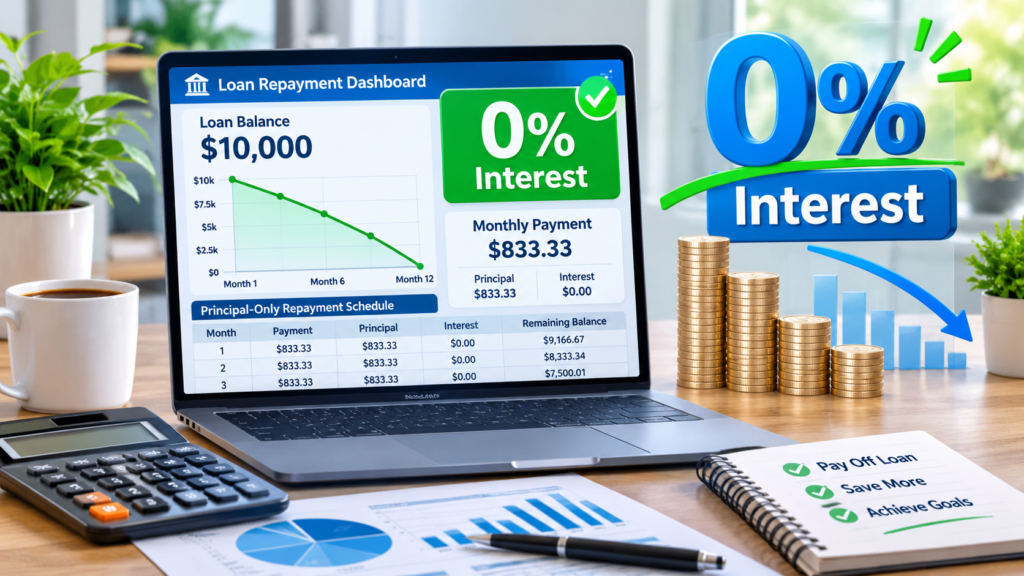
If the interest rate on a loan is 0%, every payment you make goes directly toward repaying the amount you borrowed. There are no interest charges added to the balance, which means the total amount repaid equals the original loan amount. As a result, monthly payments are typically lower than those on a comparable loan with interest, and the loan is paid off more efficiently.
While a zero-interest loan sounds simple, understanding how payments are calculated, what affects the repayment schedule, and whether a 0% offer is truly cost-free can help you make better borrowing decisions. This guide explains exactly what happens to your loan payment when interest is zero and what borrowers should consider before signing any agreement.
Understanding How Loan Payments Normally Work
Most loans consist of two key components:
- Principal – The amount of money borrowed.
- Interest – The cost charged by the lender for borrowing that money.
With a traditional loan, each monthly payment is divided between principal and interest. In the early stages of repayment, a larger portion of the payment often goes toward interest. As the balance decreases, more of the payment is applied to the principal.
For example, if you borrow $10,000 at a 7% annual interest rate, your monthly payments must cover both the borrowed amount and the interest accrued over time.
When the interest rate drops to 0%, the interest portion disappears entirely.
What Changes When Interest Is Zero?
A 0% interest loan eliminates borrowing costs associated with interest charges.
This means:
- Every payment reduces the principal balance.
- The total repayment amount equals the amount borrowed.
- No interest accumulates over time.
- The loan balance decreases more quickly.
- Monthly payments are easier to calculate.
Instead of paying principal plus interest, you only repay the principal according to the agreed repayment schedule.
Simple Formula for a Zero-Interest Loan
For many zero-interest installment loans:
Monthly Payment = Loan Amount ÷ Number of Payments
For example:
| Loan Amount | Loan Term | Monthly Payment |
|---|---|---|
| $1,200 | 12 months | $100 |
| $6,000 | 24 months | $250 |
| $12,000 | 48 months | $250 |
Because there is no interest, the math is straightforward.
A Worked Example
Let’s compare a zero-interest loan with a standard interest-bearing loan.
Scenario A: 0% Interest Loan
- Loan Amount: $12,000
- Interest Rate: 0%
- Term: 48 months
Calculation:
$12,000 ÷ 48 = $250 per month
Total paid:
$250 × 48 = $12,000
Total interest:
$0
Scenario B: 7% Interest Loan
- Loan Amount: $12,000
- Interest Rate: 7%
- Term: 48 months
The monthly payment would be higher because part of each payment covers interest.
At the end of the loan term:
- Total paid would exceed $12,000.
- Hundreds or even thousands of dollars could be paid in interest depending on the loan structure.
This comparison highlights one of the biggest advantages of zero-interest financing: every dollar you pay reduces your debt.
For readers interested in understanding repayment calculations, a dedicated financial calculator can simplify comparisons between different loan scenarios. Tools available on FinTool can help visualize how loan terms affect monthly obligations and total repayment costs.
How Fast Does the Balance Decrease?
With a standard interest-bearing loan, part of your payment covers interest before reducing the principal.
With a 0% interest loan:
- First payment reduces principal.
- Second payment reduces principal.
- Every payment reduces principal.
The balance declines at a constant rate throughout the loan term.
For example:
$6,000 Loan Over 24 Months
| Month | Payment | Remaining Balance |
|---|---|---|
| Start | – | $6,000 |
| 1 | $250 | $5,750 |
| 2 | $250 | $5,500 |
| 3 | $250 | $5,250 |
| 4 | $250 | $5,000 |
The pattern continues until the balance reaches zero at the end of the repayment period.
Because interest never accumulates, there is no slowing effect on principal reduction.
Why Lenders Offer Zero-Interest Loans
A common question is why lenders would provide financing without charging interest.
Several reasons explain these offers:
Promotional Financing
Retailers frequently offer temporary 0% financing to encourage purchases of:
- Appliances
- Furniture
- Electronics
- Vehicles
- Home improvement projects
The goal is often to increase sales rather than earn interest income.
Manufacturer Subsidies
Car manufacturers sometimes subsidize financing promotions to attract buyers.
Instead of offering cash discounts, they provide access to low-interest or zero-interest loans.
Student and Assistance Programs
Some nonprofit organizations and government-supported programs offer interest-free financing to help individuals access education, training, or essential services.
Customer Acquisition
Financial companies sometimes use promotional 0% offers to attract new customers who may later purchase other products or services.
Does Zero Interest Always Mean Free?
Not necessarily.
A loan may advertise a 0% interest rate while still including other costs.
Borrowers should review:
Origination Fees
Some lenders charge a fee when creating the loan.
Processing Charges
Administrative or service fees can increase total borrowing costs.
Late Payment Fees
Missing payments may trigger penalties.
Deferred Interest Offers
Some promotional financing programs advertise “0% interest” for a limited period.
If the balance is not fully paid during the promotional period, interest may be charged retroactively according to the agreement.
Always read the loan terms carefully before assuming a 0% offer is truly cost-free.
The Impact of Loan Term Length
Even with zero interest, loan duration affects monthly payments.
Short-Term Loan
- Lower overall debt period
- Higher monthly payments
Example:
$6,000 loan over 12 months:
$6,000 ÷ 12 = $500 monthly
Longer-Term Loan
- Lower monthly payments
- More time to repay
Example:
$6,000 loan over 36 months:
$6,000 ÷ 36 = $166.67 monthly
Since there is no interest, extending the term typically does not increase the total amount repaid unless additional fees apply.
Benefits of Zero-Interest Loans
Zero-interest financing can provide several advantages.
Lower Borrowing Costs
The most obvious benefit is avoiding interest expenses.
Predictable Payments
Calculations are simpler because payments primarily consist of principal repayment.
Faster Equity Building
For loans financing an asset, principal reduction occurs immediately.
Easier Budgeting
Borrowers know exactly how much needs to be repaid.
Improved Debt Management
Without interest accumulation, repayment progress is easy to track.
You can use budgeting and repayment calculators available on FinTool’s personal finance resources to estimate how different repayment terms fit within your financial plan.
Potential Drawbacks to Consider
Despite the benefits, there are situations where borrowers should proceed carefully.
Larger Purchases
Zero-interest financing can encourage spending beyond your budget.
Limited Promotional Periods
Many offers last only for a defined period.
Missed Payment Risks
Failing to follow promotional conditions may trigger fees or interest.
Reduced Discounts
Some sellers offer either:
- A cash discount
- Or a 0% financing promotion
The financing option may not always be the cheaper choice.
Comparing offers carefully is essential.
Common Misconceptions About Zero-Interest Loans
“The Monthly Payment Will Always Be Tiny”
Not necessarily.
A large loan amount over a short repayment period can still create substantial monthly obligations.
“All Zero-Interest Loans Are the Same”
Different lenders may charge fees, apply conditions, or impose penalties.
“There Is No Cost at All”
Fees and lost discounts can sometimes create indirect borrowing costs.
“Longer Terms Are Always Better”
Longer repayment periods reduce monthly payments but can keep debt on your financial obligations for a longer time.
Comparing Zero Interest and Low Interest Loans
Sometimes borrowers must choose between a 0% financing offer and a discounted purchase with standard financing.
Consider this simplified example:
| Option | Purchase Price | Interest Rate |
|---|---|---|
| Discount Offer | $18,000 | Standard Loan |
| Promotional Financing | $19,000 | 0% |
The best option depends on:
- Loan term
- Available discount
- Standard interest rate
- Monthly payment affordability
Running the numbers before making a decision often reveals which option produces the lowest total cost.
Loan comparison calculators can make this process easier and help identify the true financial impact of different borrowing choices.
How to Evaluate a Zero-Interest Offer
Before accepting a 0% loan, review the following checklist:
Check the Fine Print
Understand every condition attached to the offer.
Verify Promotional Expiration Dates
Know exactly when the special rate ends.
Review All Fees
Look beyond the interest rate.
Confirm Monthly Payment Amounts
Ensure they comfortably fit your budget.
Understand Penalties
Know what happens if payments are late.
Compare Alternatives
Evaluate standard financing, cash discounts, and other lending options.
Making an informed decision can save significant money over the life of a loan.
Frequently Asked Questions
Is a 0% interest loan always the best option?
Not always. Fees, lost discounts, and promotional conditions can sometimes make alternative financing more attractive.
Can monthly payments change during a zero-interest loan?
Fixed-rate promotional financing usually keeps payments consistent, but terms vary by lender. Review your agreement carefully.
Does paying early help on a 0% loan?
Paying early can eliminate debt faster and improve cash flow, although it may not reduce borrowing costs since no interest is accruing.
Will a zero-interest loan affect my credit score?
Like most loans, responsible repayment may contribute positively to your credit history, while missed payments could have negative consequences.
Can interest be added later?
Some promotional financing arrangements include deferred-interest provisions. If requirements are not met, interest may become due according to the contract terms.
Final Thoughts
When interest is zero, your loan payment goes entirely toward the principal balance. This means you repay exactly what you borrowed, making debt reduction straightforward and easy to understand. Monthly payments are generally lower than comparable interest-bearing loans, and every payment directly reduces what you owe.
However, a 0% interest rate does not automatically mean a loan is free of costs or risks. Review fees, promotional rules, repayment schedules, and alternative financing options before making a commitment. Taking a few minutes to compare scenarios using financial planning tools such as those available on FinTool can help you choose the most cost-effective borrowing strategy for your situation.