How to Understand Effective vs. Marginal Tax Rates
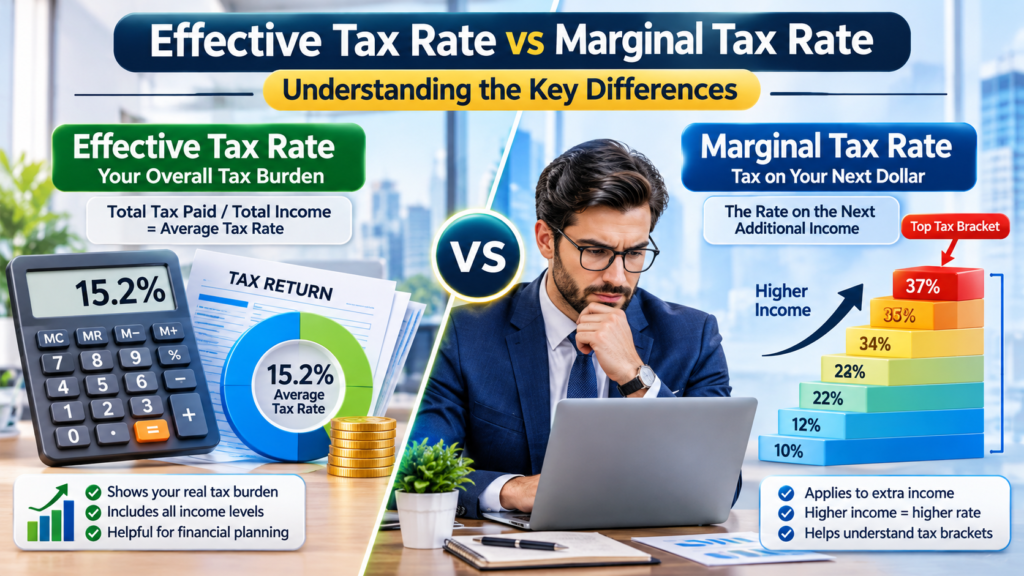
When people say they are in the 22% tax bracket, they assume 22% of all income is taxed. However, that is not how a progressive tax system works. Your marginal tax rate is the rate applied to your last dollar of taxable income. Conversely, your effective tax rate is the average rate you pay across your entire income. In short, Effective Tax Rate vs Marginal Tax Rate describes the difference between averages and last-dollar rates.
Whether you’re evaluating a raise, planning investments, or simply trying to understand your tax return, knowing how these two tax rates work is essential.
What Is a Marginal Tax Rate?
Additionally, a marginal tax rate is the percentage of tax applied to your next dollar of taxable income. In a progressive tax system, such as the U.S. federal tax system, income is divided into brackets. Each bracket is taxed at a different rate.
Moreover, the effective tax rate reflects all taxes paid on total income. In contrast, the marginal tax rate taxes only the income in the highest bracket. This distinction helps explain the difference between Effective Tax Rate vs Marginal Tax Rate. Source: https://www.irs.gov/filing/federal-income-tax-rates-and-brackets
In simple terms:
- Your marginal tax rate is your highest tax bracket.
- It affects additional income you earn.
- It determines the tax value of many deductions.
For example, if your highest taxable income falls within a 22% tax bracket, your marginal tax rate is 22%. Any additional qualifying taxable income is generally taxed at that rate until you reach the next bracket.
What Is an Effective Tax Rate?
An effective tax rate represents the average percentage of your total income paid in taxes.
The formula is straightforward:
Effective Tax Rate = Total Tax Paid ÷ Total Taxable Income × 100
Unlike the marginal tax rate, the effective tax rate considers all tax brackets that apply to your income rather than focusing only on the highest one.
Because lower portions of income are taxed at lower rates, the effective tax rate is usually lower than the marginal tax rate.
For most taxpayers, the effective tax rate provides a more realistic picture of their overall tax burden.
Effective Tax Rate vs Marginal Tax Rate: Quick Comparison
| Feature | Marginal Tax Rate | Effective Tax Rate |
|---|---|---|
| Definition | Tax rate paid on the last dollar earned | Average tax rate across all income |
| Based On | Highest tax bracket reached | Total taxes paid divided by income |
| Usually Higher or Lower? | Usually higher | Usually lower |
| Used For | Evaluating extra income and deductions | Measuring overall tax burden |
| Changes When Income Increases? | May increase if a new bracket is reached | Usually changes gradually |
| Best Used For | Tax planning decisions | Budgeting and financial analysis |
How Progressive Tax Brackets Work
Many people believe moving into a higher tax bracket means all income becomes taxed at the higher rate.
This is one of the most common tax misconceptions.
According to the IRS, only the income that falls within a higher bracket is taxed at that higher rate. Earlier portions remain taxed at lower rates.
Source: https://www.irs.gov/filing/federal-income-tax-rates-and-brackets
Think of tax brackets as buckets.
- The first bucket is taxed at the lowest rate.
- Once that bucket fills, income begins filling the next bucket.
- Each bucket has its own rate.
Your marginal tax rate simply reflects the rate of the last bucket containing your income.
Worked Example: Understanding Both Rates
Let’s assume a simplified tax structure:
| Income Range | Tax Rate |
|---|---|
| First $10,000 | 10% |
| Next $30,000 | 12% |
| Above $40,000 | 22% |
Imagine your taxable income is $50,000.
Step 1: Calculate Taxes
First $10,000:
- $10,000 × 10% = $1,000
Next $30,000:
- $30,000 × 12% = $3,600
Remaining $10,000:
- $10,000 × 22% = $2,200
Total tax:
- $1,000 + $3,600 + $2,200 = $6,800
Step 2: Find Marginal Tax Rate
Your highest income falls into the 22% bracket.
Marginal tax rate = 22%
Step 3: Find Effective Tax Rate
$6,800 ÷ $50,000 = 13.6%
Effective tax rate = 13.6%
The Result
Although your marginal rate is 22%, your overall average tax rate is only 13.6%.
This example clearly shows why the two numbers should never be confused.
Why Marginal Tax Rate Matters
The marginal tax rate becomes important whenever you’re evaluating additional income.
Considering a Raise
Suppose you receive a bonus or salary increase.
The extra earnings may be taxed at your marginal rate, not your effective rate.
This helps you estimate how much of the increase you will actually keep after taxes.
Evaluating Freelance Income
If you take on side work, your marginal tax rate helps estimate taxes owed on that additional income.
Understanding Tax Deductions
Tax deductions often provide savings based on your marginal tax rate.
For example:
- A $1,000 deduction
- Marginal tax rate of 22%
Potential tax savings:
- $1,000 × 22% = $220
This is why higher-income taxpayers typically receive greater tax savings from deductions than lower-income taxpayers.
Why Effective Tax Rate Matters
While marginal tax rates are useful for planning, effective tax rates help you understand your overall financial picture.
Budget Planning
The effective rate shows the percentage of income that ultimately goes toward taxes.
This can help when:
- Creating budgets
- Forecasting cash flow
- Managing household finances
Income Comparisons
When comparing tax burdens across years or between taxpayers, the effective tax rate is usually more informative than the marginal rate.
Assessing Financial Efficiency
Investors, business owners, and financial planners often use effective tax rates to understand real-world tax impacts.
Common Misconceptions About Tax Brackets
Myth 1: A Raise Can Leave You Worse Off
Many people worry that earning more money could push them into a higher bracket and reduce their take-home pay.
This is generally false.
Only the income above the threshold is taxed at the higher rate.
You still keep more money overall after a raise.
Myth 2: Everyone Pays Their Tax Bracket Rate on All Income
Being in a 24% tax bracket does not mean all income is taxed at 24%.
Only the income within that bracket receives that rate.
Lower portions are taxed at lower rates.
Myth 3: Effective and Marginal Rates Are the Same
In a progressive tax system, these rates are almost always different.
The effective tax rate is typically lower because portions of income are taxed across multiple brackets.
Myth 4: Higher Brackets Punish Success
Progressive taxation means higher income generates more taxes, but taxpayers still retain additional after-tax income when earnings increase.
Crossing into a higher bracket does not erase the benefit of earning more money.
How Tax Credits Affect Effective Tax Rates
Tax credits can significantly lower an effective tax rate.
Unlike deductions, which reduce taxable income, tax credits directly reduce taxes owed.
Examples include:
- Child tax credits
- Education credits
- Clean energy credits
- Earned income credits
Because credits reduce total tax liability directly, they often reduce your effective tax rate more dramatically than deductions.
This is one reason two taxpayers with similar income levels can have very different effective tax rates.
Effective Tax Rate vs Marginal Tax Rate for Investors
Investors should understand both metrics because investment decisions often involve tax consequences.
Marginal Tax Rate Helps With
- Calculating tax costs on additional income
- Roth conversion decisions
- Tax-loss harvesting strategies
- Retirement account contributions
Effective Tax Rate Helps With
- Measuring overall investment efficiency
- Retirement income planning
- Comparing tax situations across years
- Long-term financial projections
Using both rates together creates a clearer understanding of after-tax returns.
What About State and Local Taxes?
The examples above generally focus on federal income taxes.
However, many jurisdictions impose:
- State income taxes
- Local income taxes
- Payroll taxes
- Other tax obligations
These additional taxes can affect both effective and marginal tax rates.
When planning major financial decisions, it is often useful to consider your combined tax burden rather than focusing solely on federal taxes.
When Should You Focus on Marginal Tax Rate?
Pay closer attention to the marginal rate when:
- Evaluating a raise or promotion
- Taking on freelance work
- Planning retirement contributions
- Reviewing tax deductions
- Considering additional investments
- Estimating taxes on extra income
In these situations, the marginal rate offers the most relevant information.
When Should You Focus on Effective Tax Rate?
Focus on the effective rate when:
- Building a household budget
- Measuring overall tax burden
- Comparing taxes across years
- Evaluating financial progress
- Calculating long-term cash flow
The effective rate gives a broader picture of what you actually pay.
Practical Tax Planning Checklist
Use this quick checklist to better understand your tax situation:
✅ Know your current marginal tax rate
✅ Calculate your effective tax rate annually
✅ Review available deductions
✅ Take advantage of eligible tax credits
✅ Consider retirement account contributions
✅ Track taxable investment income
✅ Plan for state and local taxes
✅ Evaluate major financial decisions using marginal rates
✅ Measure overall financial impact using effective rates
Internal Resources to Improve Financial Understanding
If you’re interested in learning more about tax calculations, investment analysis, and financial planning tools, explore the resources available at FIN TOOL.BOND. Tools that help evaluate returns, compare financial scenarios, and understand tax implications can make smarter decision-making much easier.
You may also find these resources helpful:
- https://fintool.bond/
- https://fintool.bond/category/investing/
- https://fintool.bond/category/personal-finance/
Frequently Asked Questions
Is the effective tax rate always lower than the marginal tax rate?
In a progressive tax system, the effective tax rate is typically lower because various portions of income are taxed at lower rates before reaching the highest bracket.
Why do I need to know my marginal tax rate?
Your marginal rate helps estimate taxes on additional income and determines the tax value of deductions and certain financial strategies.
Which tax rate should I use for budgeting?
Your effective tax rate is generally more useful for budgeting because it reflects your actual average tax burden.
Does moving into a higher tax bracket increase taxes on all income?
No. Only the income within the higher bracket is taxed at the higher rate. Income in lower brackets keeps its lower rates.
Can tax credits reduce my effective tax rate?
Yes. Tax credits directly reduce taxes owed and can significantly lower your effective tax rate.
Final Thoughts
Understanding the difference between an effective tax rate and a marginal tax rate can remove much of the confusion surrounding taxes. The marginal rate tells you what happens to your next dollar of income, while the effective rate shows your overall tax burden. Both figures are valuable, but they serve different purposes.
Use your marginal tax rate when evaluating additional income, deductions, and tax strategies. Use your effective tax rate when assessing the bigger financial picture. Together, they provide a more accurate foundation for tax planning and smarter financial decisions.