How to Estimate Your Fixed Deposit Maturity Amount
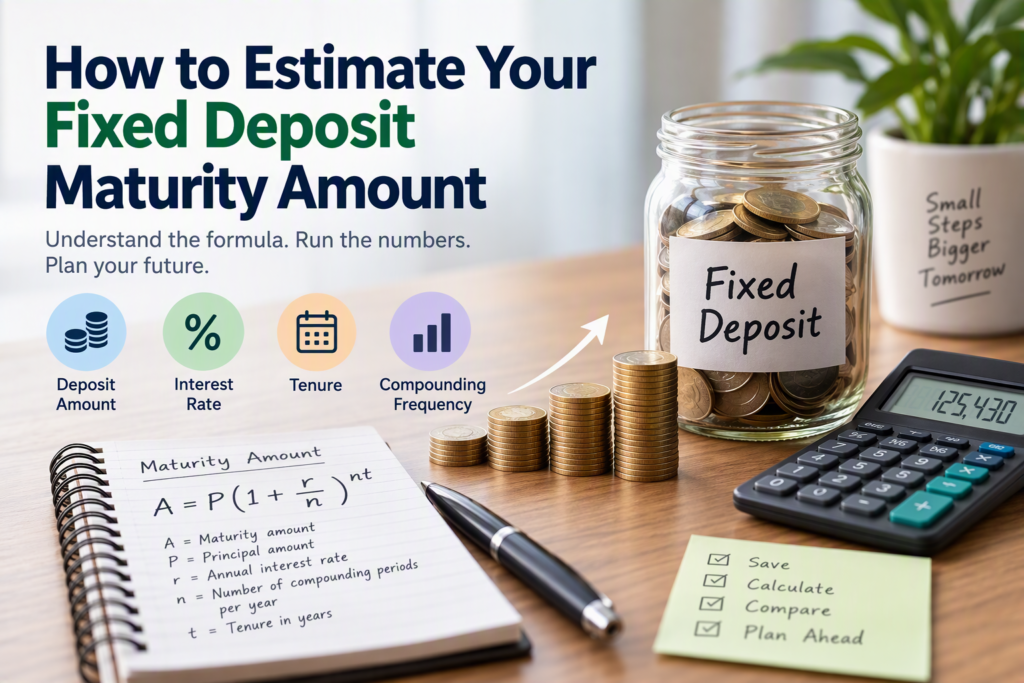
A fixed deposit (FD) maturity amount is the total sum you receive when your deposit term ends. It includes your original investment (principal) plus the interest earned over the deposit period. You can estimate this amount using a simple formula that takes into account the deposit amount, interest rate, tenure, and compounding frequency. Understanding how the calculation works helps you compare FD options, plan future expenses, and set realistic savings goals.
Whether you are investing for a short-term objective or building a secure savings portfolio, knowing how to estimate your fixed deposit maturity amount can help you make better financial decisions.
What Is a Fixed Deposit Maturity Amount?
When you open a fixed deposit account, you agree to invest a specific amount of money for a fixed period at a predetermined interest rate. At maturity, the bank or financial institution returns:
- Your original deposit amount
- The interest earned during the tenure
The combined value is known as the maturity amount.
For example:
- Deposit Amount: $10,000
- Interest Rate: 6% per year
- Tenure: 3 years
The final maturity amount will be higher than $10,000 because interest accumulates throughout the investment period.
Key Factors That Affect FD Maturity Amount
Before calculating your estimated returns, it is important to understand the variables involved.
1. Principal Amount
This is the initial amount deposited into the fixed deposit account.
Example:
- Principal: $5,000
- Principal: $20,000
- Principal: $100,000
A larger principal generally produces higher interest earnings.
2. Interest Rate
The interest rate offered by the bank directly affects your returns.
For example:
- 4% annual interest
- 5.5% annual interest
- 7% annual interest
Even a small difference in interest rates can significantly affect long-term earnings.
3. Deposit Tenure
The tenure is the period for which your funds remain invested.
Common FD terms include:
- 6 months
- 1 year
- 3 years
- 5 years
- 10 years
Longer tenures often generate higher returns because interest compounds over a longer period.
4. Compounding Frequency
Compounding determines how often the earned interest is added back to the principal.
Common compounding frequencies include:
| Compounding Type | Frequency |
|---|---|
| Annually | Once per year |
| Semi-annually | Twice per year |
| Quarterly | Four times per year |
| Monthly | Twelve times per year |
More frequent compounding generally results in a higher maturity value.
Formula for Calculating Fixed Deposit Maturity Amount
Most fixed deposits use the compound interest formula:
A = P (1 + r/n)^(nt)
Where:
- A = Maturity amount
- P = Principal amount
- r = Annual interest rate (decimal form)
- n = Number of compounding periods per year
- t = Deposit tenure in years
This formula calculates the total value of your investment at maturity.
Step-by-Step FD Maturity Calculation Example
Let us calculate the maturity amount using a practical example.
Example Details
- Principal Amount: $10,000
- Interest Rate: 6% annually
- Tenure: 3 years
- Compounded Quarterly
Step 1: Convert Variables
- P = 10,000
- r = 0.06
- n = 4
- t = 3
Step 2: Apply the Formula
A = 10,000 × (1 + 0.06/4)^(4×3)
A = 10,000 × (1.015)^12
A ≈ 10,000 × 1.1956
A ≈ $11,956
Result
- Original Deposit: $10,000
- Interest Earned: $1,956
- Maturity Amount: $11,956
This estimate shows how quarterly compounding increases the overall return.
Estimating FD Maturity Amount Using Simple Interest
Some fixed deposits or similar savings products may use simple interest instead of compound interest.
The formula is:
Interest = Principal × Rate × Time
The maturity amount becomes:
Maturity Amount = Principal + Interest
Example
- Principal = $10,000
- Interest Rate = 6%
- Tenure = 3 years
Interest:
10,000 × 0.06 × 3 = $1,800
Maturity Amount:
10,000 + 1,800 = $11,800
Compared to the compound interest example, the final value is slightly lower because interest is not earned on previously accumulated interest.
Quick FD Maturity Estimates
The table below provides approximate maturity values for a $10,000 deposit at 6% annual interest with annual compounding.
| Tenure | Maturity Amount |
|---|---|
| 1 Year | $10,600 |
| 2 Years | $11,236 |
| 3 Years | $11,910 |
| 4 Years | $12,625 |
| 5 Years | $13,382 |
These figures are estimates and may vary based on compounding frequency and institution-specific calculations.
How Compounding Frequency Changes Returns
Many investors underestimate the impact of compounding.
Consider a $50,000 deposit at 6% for 5 years.
| Compounding Frequency | Estimated Maturity Amount |
|---|---|
| Annual | $66,911 |
| Semi-Annual | $67,196 |
| Quarterly | $67,341 |
| Monthly | $67,450 |
While the differences may appear small, larger deposits and longer tenures can amplify the effect.
Using an FD Calculator
One of the easiest ways to estimate a maturity amount is by using an online fixed deposit calculator.
Most calculators require only:
- Deposit amount
- Interest rate
- Investment term
- Compounding frequency
After entering these values, the calculator instantly displays:
- Maturity amount
- Total interest earned
- Investment growth over time
Online calculators reduce errors and allow you to compare multiple deposit options quickly.
How to Compare Two Fixed Deposit Offers
When choosing between fixed deposit products, focus on more than just the advertised interest rate.
Example Comparison
| Feature | FD Option A | FD Option B |
|---|---|---|
| Principal | $20,000 | $20,000 |
| Interest Rate | 6.0% | 5.8% |
| Tenure | 5 Years | 5 Years |
| Compounding | Annual | Quarterly |
Although Option A offers a slightly higher nominal rate, the actual maturity values may be closer than expected because of compounding differences.
Always compare:
- Effective annual return
- Compounding frequency
- Early withdrawal penalties
- Minimum deposit requirements
- Deposit insurance protections where applicable
Common Mistakes When Estimating FD Returns
Many investors make errors that lead to overly optimistic expectations.
Ignoring Compounding Frequency
Two deposits with the same interest rate can produce different maturity values if the compounding schedule differs.
Using the Wrong Tenure
Ensure the calculation reflects the exact duration of the deposit, including partial years when applicable.
Forgetting Taxes
In many countries, interest earned on fixed deposits is taxable.
Your actual post-tax returns may be lower than the maturity amount quoted by the bank. Tax treatment varies by jurisdiction, so review local regulations or consult a qualified tax professional.
Assuming Rates Never Change
Fixed deposit rates can vary between institutions and product offerings. Always confirm the current rate before investing.
Overlooking Early Withdrawal Rules
Breaking an FD before maturity may lead to:
- Reduced interest payments
- Penalty charges
- Recalculated returns
This can significantly reduce the amount received.
Why Estimating FD Maturity Amount Matters
Understanding your expected maturity value provides several advantages.
Better Financial Planning
Knowing exactly how much money you will receive helps you prepare for:
- Education expenses
- Home purchases
- Travel plans
- Retirement goals
- Emergency funds
Easier Goal Tracking
You can determine whether your current deposit amount is sufficient to reach your target savings objective.
Improved Investment Comparisons
Calculating maturity values allows you to compare fixed deposits with:
- Savings accounts
- Money market accounts
- Bonds
- Certificates of deposit (CDs)
- Other low-risk investments
Reduced Financial Uncertainty
A clear estimate removes guesswork and helps set realistic expectations about future returns.
When Fixed Deposits Work Best
Fixed deposits are generally most suitable for individuals seeking:
- Capital preservation
- Predictable returns
- Low investment risk
- Short- to medium-term savings goals
They may be a useful component of a diversified financial strategy, particularly for conservative investors who prioritize stability over higher but less predictable returns.
Frequently Asked Questions
How do I calculate my FD maturity amount manually?
Use the compound interest formula:
A = P (1 + r/n)^(nt)
Substitute your deposit amount, interest rate, tenure, and compounding frequency to estimate the final maturity value.
What information is needed to calculate FD maturity value?
You need:
- Principal amount
- Annual interest rate
- Deposit tenure
- Compounding frequency
Does a higher interest rate always result in a higher maturity amount?
Generally yes, assuming the principal amount and tenure remain the same. However, compounding frequency and fees can also affect the final return.
Are fixed deposit maturity amounts guaranteed?
In most cases, the maturity amount is predictable if the deposit is held until maturity and the institution honors its contractual terms. Deposit protection rules vary by country and financial institution.
What happens if I withdraw before maturity?
Many banks impose penalties or reduced interest rates on early withdrawals, which can lower your final returns.
Final Thoughts
Estimating your fixed deposit maturity amount is straightforward once you understand the role of the principal, interest rate, tenure, and compounding frequency. A simple calculation can reveal how much your savings may grow over time and help you select the most suitable fixed deposit product.
Before opening an FD, compare rates, verify the compounding schedule, understand any withdrawal penalties, and consider the tax treatment of interest earnings in your jurisdiction. Taking a few minutes to calculate your expected maturity value can make your savings plan more accurate and effective.