How Regular Monthly Contributions Build Savings
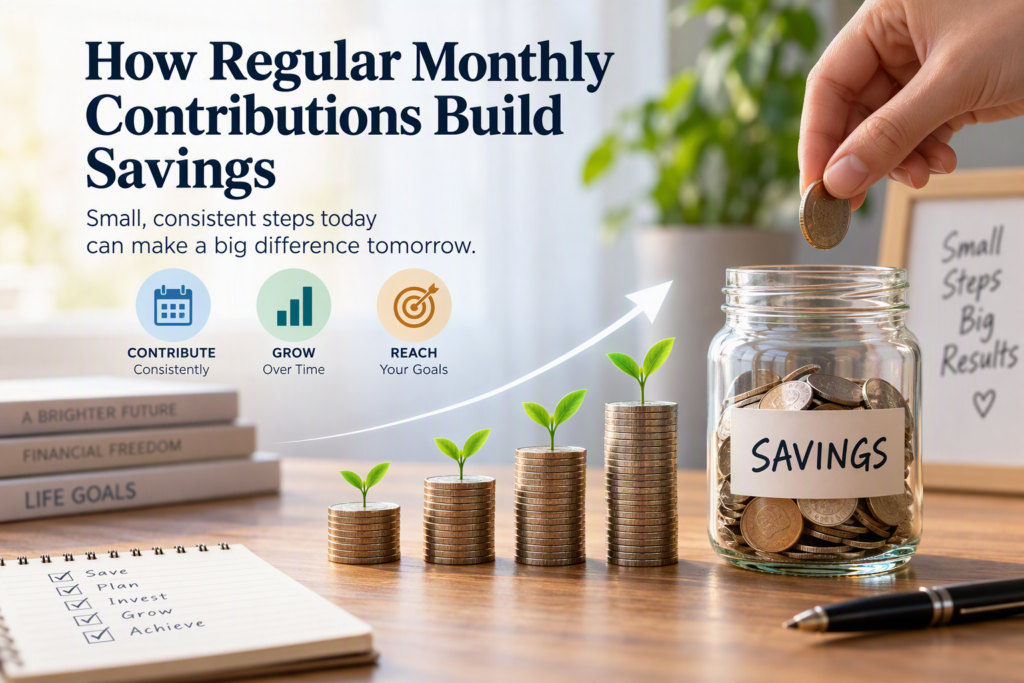
The simplest way to grow savings is not by finding the perfect investment or waiting for a larger income. It is by contributing money consistently every month. Regular monthly contributions help build savings through a combination of discipline, habit, compounding, and steady growth over time. Even modest amounts can accumulate into a substantial financial cushion when added consistently over months and years.
Whether you are saving for an emergency fund, a home purchase, retirement, education, or a major life goal, the habit of monthly contributions can be more powerful than occasional large deposits. Understanding how this process works can help you stay motivated and make smarter financial decisions.
What Are Regular Monthly Contributions?
Regular monthly contributions are fixed amounts of money that you deposit into a savings account, investment account, retirement fund, or other savings vehicle every month.
For example:
- Saving $50 every month
- Transferring $200 from each paycheck into a savings account
- Investing $500 monthly into an index fund
- Making automatic contributions to a retirement account
The key element is consistency. Instead of trying to save whatever remains at the end of the month, you commit to saving a specific amount on a scheduled basis.
This approach creates a predictable savings pattern that helps financial goals become achievable over time.
Why Consistency Matters More Than Amount
Many people believe they need a large income before they can save effectively. In reality, consistent contributions often outperform sporadic larger deposits because they establish a long-term habit.
Consider these examples:
| Saver | Monthly Deposit | Years Saved |
|---|---|---|
| Person A | $100 | 10 Years |
| Person B | $1,200 Once Per Year | 10 Years |
Both save the same annual amount, but Person A develops a monthly habit that is easier to maintain and budget around.
Consistency offers several advantages:
- Reduces the temptation to spend extra cash
- Makes saving automatic rather than emotional
- Creates measurable progress
- Encourages long-term thinking
- Builds financial discipline
A reliable system often matters more than a perfect savings strategy.
The Power of Compounding
One of the biggest reasons monthly contributions work so well is compounding.
Compounding occurs when earnings generate additional earnings. In other words, your money earns returns, and those returns begin earning returns as well.
Imagine contributing $200 each month into an account earning a modest annual return.
During the first year:
- You contribute $2,400
- The account earns interest or investment gains
- Future earnings are calculated on both your contributions and previous gains
Over time, the growth curve becomes steeper because more money is working on your behalf.
Why Starting Early Matters
Time is one of the most valuable factors in saving.
Consider three savers:
| Saver | Monthly Contribution | Start Age | Saving Period |
|---|---|---|---|
| A | $200 | 25 | 40 Years |
| B | $200 | 35 | 30 Years |
| C | $200 | 45 | 20 Years |
Even with identical monthly contributions, Saver A generally accumulates significantly more because the money has additional years to grow.
This illustrates an important principle:
Small amounts saved early can outperform larger amounts saved later.
Building Financial Security Step by Step
Savings provide protection against uncertainty.
Life can bring unexpected expenses such as:
- Medical bills
- Vehicle repairs
- Home maintenance
- Job loss
- Family emergencies
Without savings, these situations often lead to debt.
Regular contributions gradually create an emergency fund that can reduce financial stress and improve decision-making during difficult periods.
For example:
- Saving $100 monthly creates $1,200 after one year
- Saving $250 monthly creates $3,000 after one year
- Saving $500 monthly creates $6,000 after one year
Even without significant investment returns, consistent deposits can create meaningful financial protection.
How Automatic Saving Increases Success
Automation is one of the most effective tools for building savings.
When transfers happen automatically:
- You remove the need for repeated decisions
- Savings become a routine expense
- Missed contributions are less likely
- Spending adjusts around what remains
Many banks and financial institutions allow automatic transfers between accounts on a specific day each month.
A common strategy is to schedule transfers immediately after receiving income.
This follows the “pay yourself first” principle, where savings become a priority instead of an afterthought.
A Worked Example of Monthly Saving
Let’s examine a simple scenario.
Sarah wants to build a savings fund for a future home purchase.
She commits to saving $300 every month.
Year 1
- Monthly contribution: $300
- Annual contribution: $3,600
Year 5
- Total contributions: $18,000
Year 10
- Total contributions: $36,000
Without considering investment growth, Sarah has already built a substantial amount simply through consistency.
If her savings earn interest or investment returns, her balance could be considerably higher over the same period.
The lesson is straightforward:
Steady monthly action can create significant results without requiring dramatic sacrifices.
Savings vs. Investing: Understanding the Difference
Regular monthly contributions can be directed toward either savings accounts or investment accounts.
Traditional Savings Accounts
Best for:
- Emergency funds
- Short-term financial goals
- Cash reserves
Advantages:
- Easy access to money
- Low risk
- Predictable balance
Limitations:
- Lower growth potential
- Inflation may reduce purchasing power over time
Investment Accounts
Best for:
- Retirement planning
- Long-term wealth building
- Goals more than several years away
Advantages:
- Higher growth potential
- Compound returns can accelerate savings growth
Limitations:
- Market fluctuations
- Potential for short-term losses
The appropriate option depends on your goals, timeline, and risk tolerance.
How Monthly Contributions Reduce Financial Stress
Financial stress often results from uncertainty rather than income alone.
Having a growing savings balance can provide:
- Greater confidence
- Better emergency preparedness
- More flexibility during life changes
- Reduced reliance on credit cards or loans
People with established savings frequently have more options when facing financial challenges.
For example, someone with an emergency fund may be able to:
- Cover unexpected repairs
- Handle temporary income disruptions
- Avoid high-interest borrowing
Even a modest savings balance can significantly improve peace of mind.
Common Mistakes That Slow Savings Growth
While monthly contributions are effective, certain habits can limit results.
Saving Only When Money Is Left Over
Many people save whatever remains at the end of the month.
The problem is that spending often expands to consume available income.
A fixed monthly contribution usually produces better results.
Increasing Lifestyle Costs Too Quickly
When income rises, spending often rises as well.
Instead of directing every raise toward new expenses, consider increasing monthly savings contributions.
Stopping After Reaching Small Goals
Achieving an emergency fund is excellent, but financial goals constantly evolve.
After reaching one milestone, redirect contributions toward:
- Retirement
- Education
- Homeownership
- Investments
- Long-term wealth building
Ignoring Inflation
Money loses purchasing power over time.
If your income grows, periodically review and increase contributions to maintain progress toward your goals.
Strategies to Increase Monthly Contributions
Building savings does not always require major life changes.
Small adjustments can free up funds for regular saving.
Consider:
- Reviewing subscription services
- Reducing impulse purchases
- Creating a monthly spending plan
- Using bonuses for savings goals
- Directing part of future raises into savings
- Paying off high-interest debt to improve cash flow
Even increasing contributions by $25 or $50 per month can make a noticeable difference over several years.
Setting Realistic Savings Goals
Goals help transform saving from an abstract concept into a practical plan.
A strong savings goal should include:
- A target amount
- A timeline
- A monthly contribution requirement
For example:
| Goal | Target Amount | Timeline | Monthly Savings Needed |
|---|---|---|---|
| Emergency Fund | $6,000 | 24 Months | $250 |
| Vacation | $2,400 | 12 Months | $200 |
| Home Down Payment | $24,000 | 5 Years | $400 |
| Education Fund | $12,000 | 4 Years | $250 |
Specific goals provide direction and make progress easier to measure.
The Psychology Behind Successful Saving
Saving is not only about mathematics. It is also about behavior.
Regular contributions work because they reduce reliance on motivation.
Motivation changes from week to week.
Habits are more stable.
When saving becomes an automatic monthly routine:
- Decisions become easier
- Financial discipline strengthens
- Progress becomes visible
- Long-term goals stay in focus
The most successful savers often rely on systems rather than willpower alone.
A Simple Monthly Savings Checklist
Use this checklist to strengthen your savings plan:
✓ Set a specific financial goal
✓ Determine an affordable monthly contribution
✓ Automate transfers whenever possible
✓ Track progress monthly
✓ Review contributions annually
✓ Increase savings when income grows
✓ Maintain an emergency fund
✓ Avoid withdrawing savings unnecessarily
Following these basic steps can help keep your savings strategy on track.
Frequently Asked Questions
How much should I save each month?
There is no universal amount. The best contribution is one you can maintain consistently while covering essential expenses and obligations. Even small amounts can grow significantly over time.
What if I can only save a small amount?
Small contributions are still valuable. Saving $25, $50, or $100 monthly builds both financial resources and positive habits. Consistency is often more important than starting with a large amount.
Should I save or pay off debt first?
This depends on the type of debt and your financial situation. Many people benefit from building a small emergency fund while prioritizing repayment of high-interest debt. Consider seeking professional financial advice for personalized guidance.
Can I skip contributions occasionally?
Occasional interruptions happen, but frequent gaps reduce long-term progress. Automation and budgeting can help maintain consistency.
Are monthly contributions better than annual deposits?
For many people, monthly contributions are easier to manage and support stronger saving habits. They also allow money to begin working earlier rather than waiting for a yearly contribution.
The Bottom Line
Regular monthly contributions build savings by combining consistency, discipline, and long-term growth. They help create financial security, support major life goals, and reduce the need to rely on debt during unexpected situations. While the amount saved matters, the habit of contributing every month is often the real driver of long-term success.
Start with an amount that fits comfortably within your budget, automate the process if possible, and review your progress regularly. Over time, those steady monthly deposits can develop into a meaningful financial resource that supports both your short-term needs and future ambitions.