Simple Interest vs Compound Interest: A Beginner’s Guide
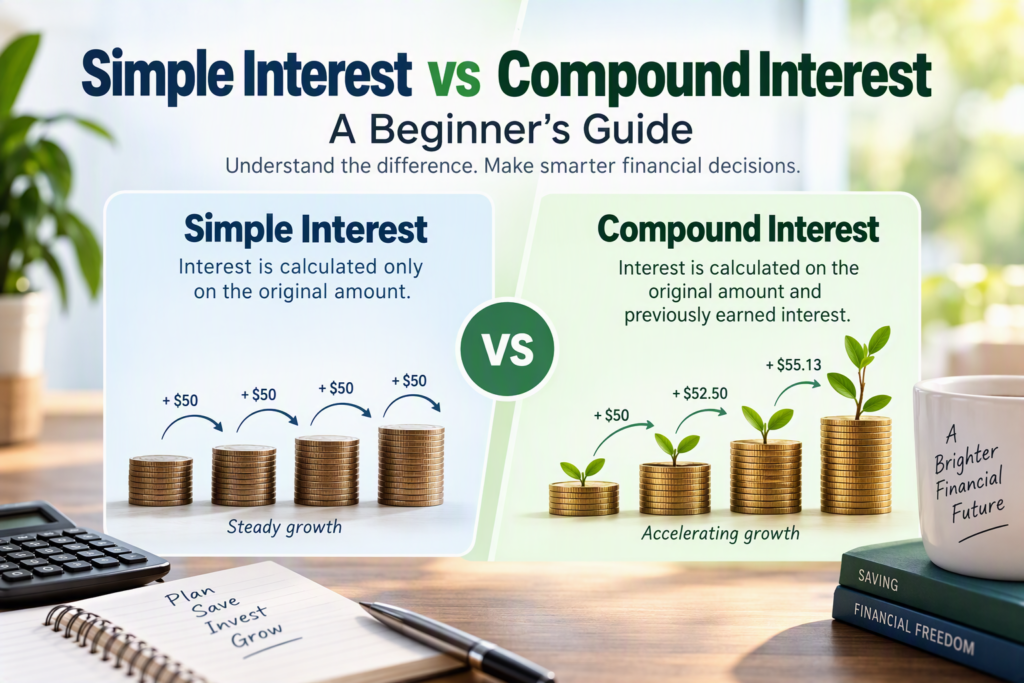
If you’re borrowing money, saving for a goal, or investing for the future, understanding the difference between simple interest and compound interest can help you make smarter financial decisions. The short answer is this: simple interest is calculated only on the original amount of money, while compound interest is calculated on both the original amount and previously earned interest. Over time, compound interest can produce significantly larger returns or costs.
This guide explains how each type of interest works, how to calculate them, and when you are likely to encounter them in everyday financial products.
What Is Interest?
Interest is the cost of borrowing money or the reward for saving and investing it.
- If you borrow money through a loan, you pay interest to the lender.
- If you deposit money into a savings account or investment, you may earn interest from the financial institution.
Interest is usually expressed as an annual percentage rate. The way that interest is calculated determines whether it is simple interest or compound interest.
What Is Simple Interest?
Simple interest is calculated only on the original amount of money, known as the principal.
The interest earned or charged remains the same during each period because the calculation never includes previously earned interest.
Simple Interest Formula
Simple Interest = Principal × Rate × Time
Where:
- Principal = the original amount
- Rate = annual interest rate (in decimal form)
- Time = number of years
Simple Interest Example
Suppose you invest $1,000 at an annual interest rate of 5% for 3 years.
Calculation:
- Principal = $1,000
- Rate = 0.05
- Time = 3
Simple Interest = $1,000 × 0.05 × 3
Simple Interest = $150
Total amount after 3 years:
$1,000 + $150 = $1,150
Because the interest is based only on the original $1,000, the earnings increase by the same amount every year.
| Year | Balance | Interest Earned |
|---|---|---|
| 1 | $1,050 | $50 |
| 2 | $1,100 | $50 |
| 3 | $1,150 | $50 |
Notice that the annual interest stays at $50.
What Is Compound Interest?
Compound interest is calculated on both the original principal and previously accumulated interest.
This means that interest earns interest over time, causing growth to accelerate. This effect is often called compounding.
Compound Interest Formula
A = P(1 + r/n)^(nt)
Where:
- A = final amount
- P = principal
- r = annual interest rate
- n = number of compounding periods per year
- t = number of years
While the formula may look complicated, many online calculators can perform the calculation automatically.
Compound Interest Example
Suppose you invest:
- Principal = $1,000
- Interest rate = 5% annually
- Time = 3 years
- Compounded annually
Year 1:
$1,000 × 5% = $50
New balance = $1,050
Year 2:
$1,050 × 5% = $52.50
New balance = $1,102.50
Year 3:
$1,102.50 × 5% = $55.13
Final balance = $1,157.63
Total earnings:
$1,157.63 − $1,000 = $157.63
Compared with simple interest’s $150 earnings, compound interest generates slightly more in just three years. The difference becomes much larger over longer periods.
| Year | Balance | Interest Earned |
|---|---|---|
| 1 | $1,050.00 | $50.00 |
| 2 | $1,102.50 | $52.50 |
| 3 | $1,157.63 | $55.13 |
The interest earned grows each year because it is calculated on a larger balance.
Simple Interest vs Compound Interest: Key Differences
| Feature | Simple Interest | Compound Interest |
|---|---|---|
| Calculation Base | Original principal only | Principal plus accumulated interest |
| Growth Rate | Linear | Accelerating |
| Earnings Over Time | Lower | Higher |
| Complexity | Easy to calculate | More complex |
| Common Uses | Short-term loans, some personal loans | Savings accounts, investments, credit cards |
| Impact of Time | Limited | Significant |
The biggest difference is that compound interest creates a snowball effect. The longer money remains invested or borrowed, the greater the impact.
Why Compound Interest Is Often Called the “Eighth Wonder”
This phrase is commonly used in financial education because compounding can produce dramatic results over long periods.
Consider two people:
Investor A
- Invests $10,000
- Earns 7% simple interest
- Holds for 30 years
Interest earned:
$10,000 × 0.07 × 30 = $21,000
Final amount:
$31,000
Investor B
- Invests $10,000
- Earns 7% compound interest annually
- Holds for 30 years
Final amount:
Approximately $76,123
The difference is striking. Compound interest produces more than twice the ending value because the earnings themselves generate additional earnings.
How Compounding Frequency Affects Growth
Compound interest can be applied at different intervals.
Common compounding frequencies include:
- Annually
- Semi-annually
- Quarterly
- Monthly
- Daily
The more frequently interest compounds, the faster the balance grows.
Example
A $5,000 investment earning 6% will generally grow more when compounded monthly than when compounded annually because interest gets added to the balance more often.
The difference may appear small in the short term but can become meaningful over many years.
When Is Simple Interest Used?
Simple interest is often used in situations where calculations need to remain straightforward.
Examples include:
Auto Loans
Some auto loans calculate interest using simple interest methods based on the remaining principal balance.
Short-Term Loans
Certain short-duration lending products may use simple interest calculations.
Basic Educational Examples
Many financial literacy programs begin with simple interest because it is easier to understand.
Treasury and Fixed-Term Products
Some financial products use methods similar to simple interest for shorter durations.
Always check the terms of a specific product because interest calculations can vary by lender and jurisdiction.
When Is Compound Interest Used?
Compound interest is far more common in long-term saving and investing.
Savings Accounts
Banks may compound interest daily, monthly, or quarterly.
Certificates of Deposit (CDs)
Many CDs use compound interest to increase returns over time.
Retirement Accounts
Retirement investments often rely heavily on compounding for long-term growth.
Mutual Funds and Investment Portfolios
Reinvested earnings and dividends can create compounding effects.
Credit Cards
Unfortunately, compound interest also works against borrowers. Unpaid balances can accumulate interest on top of previous interest charges, increasing debt costs over time.
A Real-World Comparison
Imagine two savings options for a five-year period.
Option 1: Simple Interest
- Deposit: $5,000
- Interest rate: 6%
- Term: 5 years
Interest earned:
$5,000 × 0.06 × 5 = $1,500
Final value:
$6,500
Option 2: Compound Interest
- Deposit: $5,000
- Rate: 6%
- Compounded annually
- Term: 5 years
Final value:
Approximately $6,691
Additional earnings from compounding:
About $191
The gap grows even larger if the investment remains untouched for 10, 20, or 30 years.
Common Misconceptions About Interest
Higher Interest Rate Always Means Better Returns
Not necessarily.
A product offering 5% compounded monthly may outperform another product offering a similar rate under different conditions.
Always compare:
- Interest rate
- Compounding frequency
- Fees
- Term length
Compounding Creates Instant Wealth
Compound interest is powerful, but it requires time.
A modest return over several decades often outperforms chasing unusually high returns for a short period.
Interest Only Matters for Investors
Borrowers should understand interest calculations as well.
The type of interest applied to loans can significantly affect the total amount repaid.
Compound Interest Is Always Beneficial
Compound interest benefits savers and investors but can increase borrowing costs. Carrying credit card debt for long periods can become expensive because interest may accumulate on prior interest.
How to Benefit From Compound Interest
If your goal is wealth building, consider these strategies:
Start Early
Time is one of the most important factors in compounding. Even small contributions can grow substantially over decades.
Reinvest Earnings
Allow dividends, interest payments, or investment gains to remain invested whenever possible.
Contribute Consistently
Regular deposits increase the amount available to compound.
Avoid Unnecessary Withdrawals
Removing funds interrupts the compounding process and can reduce long-term growth.
Compare Financial Products Carefully
Review:
- Annual percentage yield (APY)
- Compounding frequency
- Fees
- Minimum balance requirements
A Quick Calculation Shortcut
If you want a rough estimate of how long it may take for an investment to double through compounding, many investors use the Rule of 72.
Formula:
72 ÷ Annual Interest Rate = Approximate Years to Double
Example:
72 ÷ 6 = 12
An investment earning roughly 6% annually may double in about 12 years.
This is only an estimate, but it provides a useful way to visualize compound growth.
FAQs
Which is better: simple interest or compound interest?
For saving and investing, compound interest is generally better because it produces greater growth over time. For borrowing, simple interest is often less expensive because interest is calculated only on the original balance.
Can a loan use compound interest?
Yes. Credit cards and some loan products use compounding methods. Borrowers should carefully review loan terms to understand how interest is calculated.
Does compound interest always earn more than simple interest?
Given the same principal, interest rate, and time period, compound interest will typically generate more earnings because interest accumulates on prior interest.
How often should interest compound?
More frequent compounding generally leads to slightly higher returns. Daily or monthly compounding often produces greater growth than annual compounding at the same rate.
Why is time so important in compound interest?
The longer money remains invested, the more opportunities interest has to build upon itself. Time magnifies the benefits of compounding.
Final Thoughts
Understanding simple interest versus compound interest is one of the most important foundations of personal finance. Simple interest grows at a steady, predictable pace, while compound interest builds momentum by earning interest on previous earnings.
For borrowers, knowing the difference can help you estimate the true cost of a loan. For savers and investors, understanding compounding can highlight the value of starting early, reinvesting earnings, and staying invested for the long term.
The next step is simple: review your savings accounts, investments, or loans and identify how interest is calculated. That single detail can have a major impact on your financial future.