How Inflation Changes the Value of Your Savings
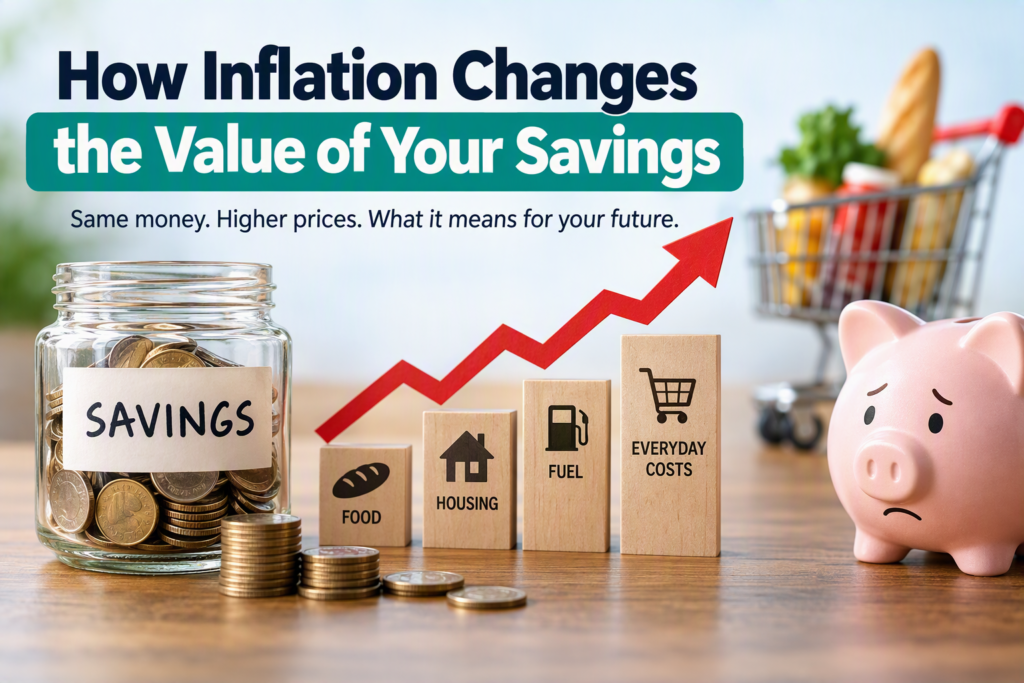
If your savings account earns less interest than the inflation rate, the real value of your money declines over time. In simple terms, you may see the same balance, or even a larger balance, in your account, but that money can buy fewer goods and services than before. Understanding how inflation affects savings is essential for protecting your purchasing power and making smarter financial decisions.
Many people focus on how much money they have saved. Equally important is what that money can actually buy in the future. Inflation quietly influences the value of every dollar, euro, pound, or rupee you set aside. Learning how it works can help you choose better saving and investing strategies.
What Is Inflation?
Inflation is the rate at which prices for goods and services increase over time. As prices rise, each unit of currency buys less than it did previously.
For example, if a loaf of bread costs $2 today and inflation averages 5% per year, that same loaf may cost approximately $2.10 next year. While the increase may seem small at first, inflation compounds over time, creating a significant impact on household budgets and savings.
Central banks, economists, and governments closely monitor inflation because it affects:
- Consumer spending
- Business investment
- Interest rates
- Wage growth
- Retirement planning
- Overall economic stability
Moderate inflation is considered normal in most economies. Problems arise when inflation rises much faster than incomes or savings returns.
The Difference Between Nominal and Real Value
To understand inflation’s effect on savings, it helps to know two key terms:
Nominal Value
The nominal value is the amount of money you see in your account.
For example:
- Savings balance: $10,000
- Interest earned: 2%
- New balance after one year: $10,200
Your account shows more money than before.
Real Value
The real value measures purchasing power after accounting for inflation.
If inflation during that year is 4%, your money grew by 2%, but prices rose by 4%.
The real return can be estimated as:
Real Return ≈ Interest Rate − Inflation Rate
Real Return ≈ 2% − 4% = -2%
Even though your account balance increased, your purchasing power effectively declined.
This distinction explains why many savers feel poorer despite earning interest.
How Inflation Erodes Savings
Inflation acts like a hidden tax on cash holdings.
Imagine you save $20,000 in a bank account that earns no interest.
If inflation averages 3% annually:
- Year 1 purchasing power: about $19,400
- Year 5 purchasing power: about $17,250
- Year 10 purchasing power: about $14,900
The money remains $20,000 on paper, but it buys significantly less.
The longer money sits in low-yield accounts, the greater inflation’s impact becomes.
Everyday Examples
Inflation affects nearly every category of spending:
| Item | Price Today | Price After Years of Inflation |
|---|---|---|
| Groceries | $100 | $120-$150 |
| Rent | $1,000 | $1,200-$1,500 |
| Gasoline | $50 | $60-$80 |
| Healthcare | $1,000 | Potentially much higher |
| College Tuition | $10,000 | Significantly higher |
The exact increase varies by country, region, and period, but the principle remains the same: future expenses often cost more than current expenses.
A Simple Inflation Example
Consider two savers.
Saver A
- Saves $10,000
- Earns 1% annual interest
- Inflation averages 4%
After one year:
- Account balance: $10,100
- Real purchasing power: lower than $10,000 at today’s prices
Saver B
- Saves $10,000
- Earns 5% annual return
- Inflation averages 4%
After one year:
- Account balance: $10,500
- Real gain after inflation: approximately 1%
Both savers increased their balances, but only Saver B maintained and slightly increased purchasing power.
The important lesson is that the growth rate of your money matters relative to inflation, not just in absolute terms.
Why Inflation Matters More for Long-Term Goals
Inflation has a compounding effect.
Small annual increases become large changes over decades.
Suppose inflation averages 3% annually:
- Prices roughly double in about 24 years.
- A lifestyle that costs $50,000 today may require around $100,000 in future spending.
- Retirement plans based solely on today’s expenses can fall short.
This is why long-term goals require special attention to inflation.
Examples include:
- Retirement savings
- College funds
- Home purchase plans
- Emergency reserves
- Wealth preservation
Ignoring inflation often results in underestimating future costs.
How Interest Rates Interact With Inflation
Interest rates and inflation are closely linked.
When inflation rises, central banks often raise interest rates to slow economic activity and stabilize prices.
For savers, higher rates can provide benefits:
- Better savings account yields
- Higher certificate of deposit (CD) rates
- Improved returns on certain fixed-income products
However, a higher interest rate is not always enough.
For example:
| Savings Yield | Inflation Rate | Real Outcome |
|---|---|---|
| 2% | 5% | Loss of purchasing power |
| 4% | 4% | Purchasing power maintained |
| 6% | 3% | Purchasing power increases |
The key number to watch is the real return after inflation.
Where Savings Are Most Vulnerable
Not all financial assets are equally affected by inflation.
Cash
Physical cash experiences the full effect of inflation because it earns nothing.
Money stored at home gradually loses purchasing power every year.
Low-Yield Savings Accounts
Traditional savings accounts may struggle to keep pace when inflation is elevated.
While they offer safety and liquidity, they may not preserve purchasing power over long periods.
Large Idle Balances
Keeping excessive amounts of money in checking accounts can lead to substantial long-term erosion.
This does not mean people should eliminate emergency savings. Rather, they should consider whether excess cash is being used efficiently.
Savings Options That May Help Combat Inflation
No investment completely eliminates inflation risk, but some options have historically offered better protection.
High-Yield Savings Accounts
These accounts often pay more interest than traditional savings accounts.
Benefits include:
- Easy access to money
- Lower risk
- Better returns than many standard accounts
The downside is that yields can still fall below inflation during certain periods.
Certificates of Deposit (CDs)
CDs usually offer fixed returns for a specified term.
They can be useful when interest rates are attractive, though funds may be less accessible before maturity.
Bonds
Some bonds can provide income streams that partially offset inflation.
However, inflation can reduce the real value of fixed bond payments, especially when inflation rises unexpectedly.
Inflation-Protected Securities
Some governments issue inflation-linked bonds.
Their value or interest payments adjust with inflation, helping preserve purchasing power.
Stocks
Stocks involve risk and short-term volatility but have historically provided long-term growth that exceeds inflation in many markets.
Companies often raise prices, revenues, and earnings over time, which can help investors keep pace with rising costs.
Diversified Portfolios
Many investors combine:
- Cash
- Bonds
- Stocks
- Real assets
Diversification spreads risk and can improve inflation resistance compared with relying on cash alone.
Common Mistakes Savers Make
Focusing Only on Account Balance
A larger balance does not necessarily mean increased wealth.
Purchasing power matters more than the number displayed in an account.
Ignoring Real Returns
Many people celebrate a 3% return without comparing it to inflation.
If inflation is 5%, the real outcome is negative.
Keeping Too Much Cash
Emergency funds are important, but maintaining excessive idle cash for years can be costly.
Underestimating Long-Term Inflation
Even moderate inflation significantly affects future expenses.
What feels affordable today may become much more expensive over a decade or two.
Delaying Investing Entirely
Fear of market volatility sometimes causes people to remain in cash indefinitely.
While investing carries risk, long-term inflation can also be a serious risk to wealth.
How to Calculate Inflation’s Impact on Your Savings
You can estimate future purchasing power using a simple formula:
Future Real Value = Savings ÷ (1 + Inflation Rate)^Years
Example:
- Savings: $50,000
- Inflation: 3%
- Time: 10 years
Calculation:
$50,000 ÷ (1.03)^10
Result:
Approximately $37,200 in today’s purchasing power.
Although the account might still show $50,000 or more, its buying power would be much lower if returns failed to match inflation.
Building an Inflation-Aware Savings Strategy
A practical strategy typically balances safety, liquidity, and growth.
Step 1: Maintain an Emergency Fund
Keep enough cash available for unexpected expenses.
Many households choose several months of essential living expenses, though individual needs vary.
Step 2: Separate Short-Term and Long-Term Goals
Money needed within a year or two generally belongs in safer accounts.
Longer-term goals may allow for assets with higher growth potential.
Step 3: Compare Returns to Inflation
Review your savings and investment accounts regularly.
Ask:
- What return am I earning?
- What is the current inflation rate?
- Am I gaining or losing purchasing power?
Step 4: Review Annually
Interest rates, inflation, and personal goals can change.
Regular reviews help ensure your money remains aligned with your objectives.
Inflation Myths and Misunderstandings
“Saving Money Is Pointless Because of Inflation”
False.
Savings remain essential for emergencies, short-term goals, and financial security.
The goal is not to avoid saving. The goal is to save wisely.
“More Interest Always Beats Inflation”
Not necessarily.
A 4% return may be insufficient if inflation reaches 6%.
Always compare returns to inflation.
“Inflation Only Matters During Economic Crises”
Inflation affects purchasing power even at moderate levels.
Small annual increases accumulate significantly over time.
“Retirees Are the Only People Affected”
Everyone is affected.
Workers, students, families, and business owners all experience rising costs when inflation increases.
Frequently Asked Questions
How does inflation affect money in a savings account?
Inflation reduces purchasing power. If your savings account earns less than the inflation rate, the real value of your money declines over time.
Can savings accounts beat inflation?
Sometimes. During periods of lower inflation or higher interest rates, certain savings accounts may keep pace with or exceed inflation. This is not always the case.
Is cash bad during inflation?
Cash remains useful for emergencies and short-term needs. However, holding large amounts for long periods may lead to purchasing power loss.
What is a good inflation-adjusted return?
Any return that exceeds inflation increases real purchasing power. The higher the gap between investment returns and inflation, the greater the real growth.
Why is inflation important for retirement planning?
Retirement can last decades. Even modest inflation can dramatically increase future living costs, making inflation-adjusted planning essential.
Final Thoughts
Inflation changes the value of your savings by reducing what your money can buy over time. The key measure is not simply how much your account balance grows, but whether that growth exceeds inflation. By understanding real returns, separating short-term and long-term goals, and choosing savings or investment options that align with your time horizon, you can better protect your purchasing power and keep your financial plans on track.