Skip to content
FinTool
Blog

Future Cost vs Purchasing Power: Two Ways to Measure Inflation
By mrsajid0087
Future Cost vs Purchasing Power: Two Ways to Measure Inflation Inflation can be measured in two useful ways: by looking at how much prices rise over time (future cost) and by examining how much your money can buy (purchasing power). Although both approaches describe the same economic phenomenon, they answer different questions. Future cost tells you what an item may cost years from now, while purchasing power reveals how inflation affects the real value of your income and savings. Understanding both perspectives helps you make better decisions about spending, saving, investing, and long-term financial planning. Understanding Inflation Beyond the Headline Number Most people encounter inflation as a percentage reported in economic news. A statement such as "inflation is 3% this year" seems simple enough, but that figure describes only the rate at which average prices are increasing. The practical impact of inflation becomes clearer when you view it from two angles: Future Cost: How much more money you will need to buy something in the future. Purchasing Power: How much less your current money can buy over time. These perspectives are closely connected, yet they lead to different financial insights. For example, if inflation remains at 3% annually, a product costing $100 today would cost approximately $134 after ten years. At the same time, your $100 would buy significantly less than it does today because its purchasing power would decline. The price increase and the loss of purchasing power are two sides of the same coin. The Future Cost Approach The future cost method focuses on how prices increase over time. It answers a question many consumers and investors ask: "How much will this cost in the future?" This perspective is especially useful when planning for major expenses such as: College tuition Housing Healthcare Retirement Vehicles Long-term business costs How Future Cost Is Calculated Future cost calculations typically use compound inflation. The basic formula is: Future Cost = Present Cost × (1 + Inflation Rate)^Years For example: Current cost: $10,000 Inflation rate: 3% annually Time period: 10 years Calculation: $10,000 × (1.03)^10 ≈ $13,439 In this scenario, an item costing $10,000 today may cost around $13,439 in ten years if inflation averages 3% annually. Why Future Cost Matters Future cost calculations help individuals avoid underestimating future expenses. Consider retirement planning. Many people calculate how much income they need based on today's prices. However, retirement may begin decades later. If monthly expenses are $4,000 today and inflation averages 3% annually, those same expenses could exceed $7,200 per month after twenty years. Without accounting for future costs, retirement savings targets may fall short. Common Applications Future cost analysis is widely used for: Situation Why Future Cost MattersRetirement planning Estimates future living expenses Education savings Projects future tuition costs Business budgeting Forecasts operating expenses Insurance planning Adjusts coverage needs Infrastructure projects Anticipates rising construction costs The future cost method turns abstract inflation rates into tangible dollar amounts. The Purchasing Power Approach While future cost looks forward at prices, purchasing power looks inward at the value of money. It answers a different question: "What can my money actually buy?" Purchasing power refers to the quantity of goods and services a certain amount of money can purchase at a given point in time. When inflation rises, purchasing power falls. A Simple Example Imagine you have $1,000 in cash. If inflation averages 5% annually: Prices rise. Your $1,000 remains $1,000. The amount of goods and services you can buy decreases. After several years, the money still exists, but its real value has declined. This is why financial experts often distinguish between: Nominal value: The number printed on currency. Real value: The purchasing power of that currency. Inflation mainly affects real value. Purchasing Power in Everyday Life Many people notice purchasing power changes before they notice official inflation statistics. Examples include: Grocery budgets covering fewer items. Fuel costs consuming a larger share of income. Restaurant meals becoming more expensive. Rent increasing faster than wages. Savings accounts failing to keep pace with rising prices. These experiences reflect declining purchasing power. How Future Cost and Purchasing Power Are Connected Future cost and purchasing power describe the same inflationary process from opposite directions. Consider this example: Today: Product price: $100 Money available: $100 You can buy the item. Ten years later: Product price: $134 Money available: Still $100 You can no longer buy the item. From the future cost perspective: The item's cost increased from $100 to $134. From the purchasing power perspective: Your $100 lost enough value that it can no longer purchase the item. The economic reality is identical. A Worked Example: Saving for a Child's Education Suppose parents estimate that a university education costs $50,000 today. If educational costs rise by 4% annually, what happens over 18 years? Future cost calculation: $50,000 × (1.04)^18 Result: Approximately $101,290 The projected cost is more than double the current amount. Now consider purchasing power. If the parents simply keep $50,000 in a non-interest-bearing account for eighteen years, its purchasing power relative to education expenses declines dramatically. Although they still possess $50,000 in nominal terms, that amount may cover less than half of the future educational cost. This example illustrates why both measurements matter when planning for long-term goals. The Role of Income Growth One common misconception is that inflation automatically makes people poorer. The answer depends on whether income grows alongside inflation. Scenario 1: Wages Keep Pace Suppose: Inflation: 3% Annual wage growth: 3% Prices rise, but income rises as well. Purchasing power remains relatively stable. Scenario 2: Wages Lag Behind Inflation Suppose: Inflation: 6% Wage growth: 3% Prices rise faster than income. Purchasing power declines. Even though workers earn more nominal dollars, they can afford fewer goods and services. Scenario 3: Wages Exceed Inflation Suppose: Inflation: 2% Wage growth: 5% Income grows faster than prices. Purchasing power improves. People become capable of purchasing more goods and services over time. For households, purchasing power often matters more than nominal salary increases. Inflation's Impact on Savings Inflation can quietly erode savings if returns fail to keep pace with rising prices. Imagine two situations: Keeping Cash at Home You save: $10,000 today Inflation averages 3% Ten years pass Your cash remains $10,000. However, its purchasing power falls significantly. Investing With Moderate Growth You invest: $10,000 Annual return: 5% Inflation: 3% The investment grows faster than inflation. Purchasing power increases because real wealth rises. This example demonstrates why investors focus on real returns, not just nominal returns. A nominal return is the percentage gained before accounting for inflation. A real return reflects the increase in purchasing power after inflation is considered. Why Governments and Economists Track Both Perspectives Economists examine both future costs and purchasing power because each provides different insights. Future Cost Helps Forecast Governments use future cost estimates when planning for: Infrastructure projects Public pensions Healthcare spending Education funding Long-term budgets would be inaccurate without inflation projections. Purchasing Power Reveals Living Standards Purchasing power analysis helps measure: Household financial well-being Wage growth effectiveness Consumer confidence Economic inequality A growing economy means little to consumers if purchasing power continues to decline. Common Inflation Measurement Tools Several tools help estimate inflation's impact. Consumer Price Index (CPI) The Consumer Price Index tracks changes in the cost of a representative basket of goods and services purchased by households. Many countries use CPI as their primary inflation measure. Personal Consumption Expenditures (PCE) Some central banks also monitor Personal Consumption Expenditures inflation because it reflects changing consumer behavior and spending patterns. Inflation Calculators Inflation calculators allow users to: Estimate future costs. Compare historical prices. Measure purchasing power losses. These tools are valuable for educational purposes and financial planning, though their projections depend on assumptions about future inflation rates. Common Mistakes When Thinking About Inflation Focusing Only on Rising Prices Many people notice higher prices but ignore changes in income. Real financial health depends on the relationship between earnings and inflation. Assuming Inflation Is Constant Inflation rates fluctuate over time. Long-term financial plans should consider multiple scenarios rather than relying on a single estimate. Ignoring Inflation in Savings Goals A future savings target should reflect projected costs, not today's prices. This mistake can create major shortfalls. Confusing Nominal and Real Returns Investment performance should be evaluated after accounting for inflation. A portfolio returning 6% during a period of 5% inflation provides only about 1% real growth. Using Short-Term Trends for Long-Term Planning Inflation often varies from year to year. Long-term plans benefit from realistic assumptions rather than reacting to temporary spikes or declines. Which Measurement Is More Important? Neither approach is inherently better. The most useful measure depends on the question being asked. Question Better MeasureHow much will this cost in 20 years? Future Cost Is my income keeping up with inflation? Purchasing Power How much should I save for retirement? Both Are investments preserving value? Purchasing Power What will college cost in the future? Future Cost Has my standard of living improved? Purchasing Power Financial planning often requires both perspectives simultaneously. Future cost estimates tell you how much money you will need. Purchasing power analysis tells you whether your income, savings, and investments are keeping pace with inflation. FAQs What is the difference between future cost and purchasing power? Future cost measures how much prices may rise over time. Purchasing power measures how much goods and services a given amount of money can buy. Does higher inflation always reduce purchasing power? Not necessarily. If wages, business income, or investment returns grow faster than inflation, purchasing power can still increase. Why do retirement plans use future cost projections? Retirement may occur decades in the future. Planning based on current prices alone could underestimate future living expenses. Can investments protect against inflation? Some investments may help preserve or increase purchasing power over time, especially when returns exceed inflation. However, all investments carry risks, and outcomes are not guaranteed. Why does money lose purchasing power? Money loses purchasing power when the prices of goods and services rise faster than the value of the money itself. The Bottom Line Future cost and purchasing power are two complementary ways of understanding inflation. Future cost shows how much more expensive goods and services may become over time, while purchasing power reveals how inflation affects the real value of your income, cash, and savings. Looking at only one side can create an incomplete picture. Whether you're planning for retirement, saving for education, managing a household budget, or evaluating investments, combining both perspectives provides a clearer view of inflation's true impact and helps you make more informed financial decisions.

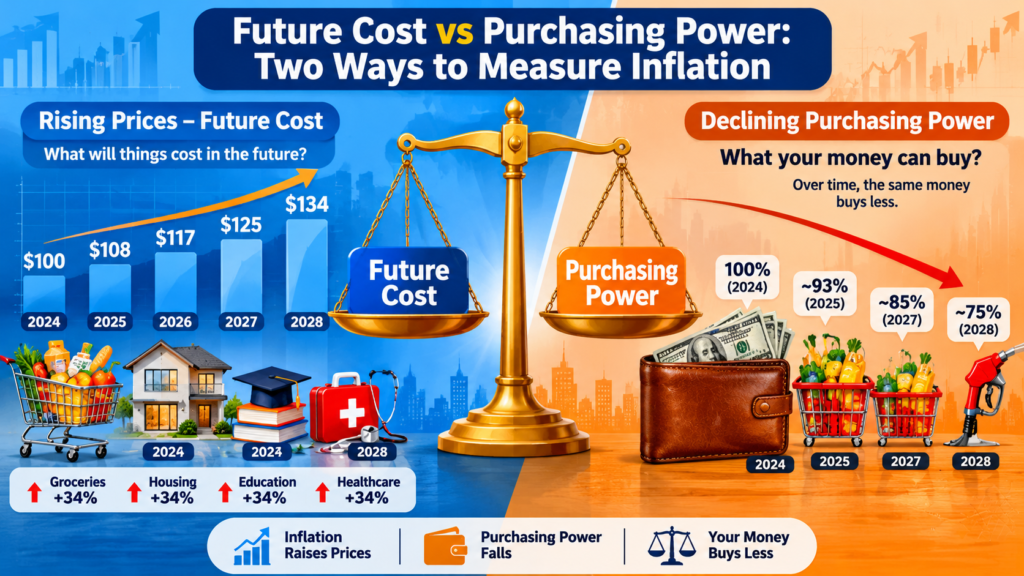
Inflation can be measured in two useful ways: by looking at how much prices rise over time (future cost) and by examining how much your money can buy (purchasing power). Although both approaches describe the same economic phenomenon, they answer different questions. Future cost tells you what an item may cost years from now, while purchasing power reveals how inflation affects the real value of your income and savings. Understanding both perspectives helps you make better decisions about spending, saving, investing, and long-term financial planning.

Understanding Inflation Beyond the Headline Number

Most people encounter inflation as a percentage reported in economic news. A statement such as “inflation is 3% this year” seems simple enough, but that figure describes only the rate at which average prices are increasing.

The practical impact of inflation becomes clearer when you view it from two angles:

  1. Future Cost: How much more money you will need to buy something in the future.
  2. Purchasing Power: How much less your current money can buy over time.

These perspectives are closely connected, yet they lead to different financial insights.

For example, if inflation remains at 3% annually, a product costing $100 today would cost approximately $134 after ten years. At the same time, your $100 would buy significantly less than it does today because its purchasing power would decline.

The price increase and the loss of purchasing power are two sides of the same coin.

The Future Cost Approach

The future cost method focuses on how prices increase over time. It answers a question many consumers and investors ask:

“How much will this cost in the future?”

This perspective is especially useful when planning for major expenses such as:

  • College tuition
  • Housing
  • Healthcare
  • Retirement
  • Vehicles
  • Long-term business costs

How Future Cost Is Calculated

Future cost calculations typically use compound inflation.

The basic formula is:

Future Cost = Present Cost × (1 + Inflation Rate)years

For example:

  • Current cost: $10,000
  • Inflation rate: 3% annually
  • Time period: 10 years

Calculation:

$10,000 × (1.03)^10 ≈ $13,439

In this scenario, an item costing $10,000 today may cost around $13,439 in ten years if inflation averages 3% annually.

Why Future Cost Matters

Future cost calculations help individuals avoid underestimating future expenses.

Consider retirement planning. Many people calculate how much income they need based on today’s prices. However, retirement may begin decades later.

If monthly expenses are $4,000 today and inflation averages 3% annually, those same expenses could exceed $7,200 per month after twenty years.

Without accounting for future costs, retirement savings targets may fall short.

Common Applications

Future cost analysis is widely used for:

SituationWhy Future Cost Matters
Retirement planningEstimates future living expenses
Education savingsProjects future tuition costs
Business budgetingForecasts operating expenses
Insurance planningAdjusts coverage needs
Infrastructure projectsAnticipates rising construction costs

The future cost method turns abstract inflation rates into tangible dollar amounts.

The Purchasing Power Approach

While future cost looks forward at prices, purchasing power looks inward at the value of money.

It answers a different question:

“What can my money actually buy?”

Purchasing power refers to the quantity of goods and services a certain amount of money can purchase at a given point in time.

When inflation rises, purchasing power falls.

A Simple Example

Imagine you have $1,000 in cash.

If inflation averages 5% annually:

  • Prices rise.
  • Your $1,000 remains $1,000.
  • The amount of goods and services you can buy decreases.

After several years, the money still exists, but its real value has declined.

This is why financial experts often distinguish between:

  • Nominal value: The number printed on currency.
  • Real value: The purchasing power of that currency.

Inflation mainly affects real value.

Purchasing Power in Everyday Life

Many people notice purchasing power changes before they notice official inflation statistics.

Examples include:

  • Grocery budgets covering fewer items.
  • Fuel costs consuming a larger share of income.
  • Restaurant meals becoming more expensive.
  • Rent increasing faster than wages.
  • Savings accounts failing to keep pace with rising prices.

These experiences reflect declining purchasing power.

How Future Cost and Purchasing Power Are Connected

Future cost and purchasing power describe the same inflationary process from opposite directions.

Consider this example:

Today:

  • Product price: $100
  • Money available: $100

You can buy the item.

Ten years later:

  • Product price: $134
  • Money available: Still $100

You can no longer buy the item.

From the future cost perspective:

  • The item’s cost increased from $100 to $134.

From the purchasing power perspective:

  • Your $100 lost enough value that it can no longer purchase the item.

The economic reality is identical.

A Worked Example: Saving for a Child’s Education

Suppose parents estimate that a university education costs $50,000 today.

If educational costs rise by 4% annually, what happens over 18 years?

Future cost calculation:

$50,000 × (1.04)^18

Result:

Approximately $101,290

The projected cost is more than double the current amount.

Now consider purchasing power.

If the parents simply keep $50,000 in a non-interest-bearing account for eighteen years, its purchasing power relative to education expenses declines dramatically.

Although they still possess $50,000 in nominal terms, that amount may cover less than half of the future educational cost.

This example illustrates why both measurements matter when planning for long-term goals.

The Role of Income Growth

One common misconception is that inflation automatically makes people poorer.

The answer depends on whether income grows alongside inflation.

Scenario 1: Wages Keep Pace

Suppose:

  • Inflation: 3%
  • Annual wage growth: 3%

Prices rise, but income rises as well.

Purchasing power remains relatively stable.

Scenario 2: Wages Lag Behind Inflation

Suppose:

  • Inflation: 6%
  • Wage growth: 3%

Prices rise faster than income.

Purchasing power declines.

Even though workers earn more nominal dollars, they can afford fewer goods and services.

Scenario 3: Wages Exceed Inflation

Suppose:

  • Inflation: 2%
  • Wage growth: 5%

Income grows faster than prices.

Purchasing power improves.

People become capable of purchasing more goods and services over time.

For households, purchasing power often matters more than nominal salary increases.

Inflation’s Impact on Savings

Inflation can quietly erode savings if returns fail to keep pace with rising prices.

Imagine two situations:

Keeping Cash at Home

You save:

  • $10,000 today
  • Inflation averages 3%
  • Ten years pass

Your cash remains $10,000.

However, its purchasing power falls significantly.

Investing With Moderate Growth

You invest:

  • $10,000
  • Annual return: 5%
  • Inflation: 3%

The investment grows faster than inflation.

Purchasing power increases because real wealth rises.

This example demonstrates why investors focus on real returns, not just nominal returns.

A nominal return is the percentage gained before accounting for inflation.

A real return reflects the increase in purchasing power after inflation is considered.

Why Governments and Economists Track Both Perspectives

Economists examine both future costs and purchasing power because each provides different insights.

Future Cost Helps Forecast

Governments use future cost estimates when planning for:

  • Infrastructure projects
  • Public pensions
  • Healthcare spending
  • Education funding

Long-term budgets would be inaccurate without inflation projections.

Purchasing Power Reveals Living Standards

Purchasing power analysis helps measure:

  • Household financial well-being
  • Wage growth effectiveness
  • Consumer confidence
  • Economic inequality

A growing economy means little to consumers if purchasing power continues to decline.

Common Inflation Measurement Tools

Several tools help estimate inflation’s impact.

Consumer Price Index (CPI)

The Consumer Price Index tracks changes in the cost of a representative basket of goods and services purchased by households.

Many countries use CPI as their primary inflation measure.

Personal Consumption Expenditures (PCE)

Some central banks also monitor Personal Consumption Expenditures inflation because it reflects changing consumer behavior and spending patterns.

Inflation Calculators

Inflation calculators allow users to:

  • Estimate future costs.
  • Compare historical prices.
  • Measure purchasing power losses.

These tools are valuable for educational purposes and financial planning, though their projections depend on assumptions about future inflation rates.

Common Mistakes When Thinking About Inflation

Focusing Only on Rising Prices

Many people notice higher prices but ignore changes in income.

Real financial health depends on the relationship between earnings and inflation.

Assuming Inflation Is Constant

Inflation rates fluctuate over time.

Long-term financial plans should consider multiple scenarios rather than relying on a single estimate.

Ignoring Inflation in Savings Goals

A future savings target should reflect projected costs, not today’s prices.

This mistake can create major shortfalls.

Confusing Nominal and Real Returns

Investment performance should be evaluated after accounting for inflation.

A portfolio returning 6% during a period of 5% inflation provides only about 1% real growth.

Using Short-Term Trends for Long-Term Planning

Inflation often varies from year to year.

Long-term plans benefit from realistic assumptions rather than reacting to temporary spikes or declines.

Which Measurement Is More Important?

Neither approach is inherently better.

The most useful measure depends on the question being asked.

QuestionBetter Measure
How much will this cost in 20 years?Future Cost
Is my income keeping up with inflation?Purchasing Power
How much should I save for retirement?Both
Are investments preserving value?Purchasing Power
What will college cost in the future?Future Cost
Has my standard of living improved?Purchasing Power

Financial planning often requires both perspectives simultaneously.

Future cost estimates tell you how much money you will need.

Purchasing power analysis tells you whether your income, savings, and investments are keeping pace with inflation.

FAQs

What is the difference between future cost and purchasing power?

Future cost measures how much prices may rise over time. Purchasing power measures how much goods and services a given amount of money can buy.

Does higher inflation always reduce purchasing power?

Not necessarily. If wages, business income, or investment returns grow faster than inflation, purchasing power can still increase.

Why do retirement plans use future cost projections?

Retirement may occur decades in the future. Planning based on current prices alone could underestimate future living expenses.

Can investments protect against inflation?

Some investments may help preserve or increase purchasing power over time, especially when returns exceed inflation. However, all investments carry risks, and outcomes are not guaranteed.

Why does money lose purchasing power?

Money loses purchasing power when the prices of goods and services rise faster than the value of the money itself.

The Bottom Line

Future cost and purchasing power are two complementary ways of understanding inflation. Future cost shows how much more expensive goods and services may become over time, while purchasing power reveals how inflation affects the real value of your income, cash, and savings. Looking at only one side can create an incomplete picture. Whether you’re planning for retirement, saving for education, managing a household budget, or evaluating investments, combining both perspectives provides a clearer view of inflation’s true impact and helps you make more informed financial decisions.

← Back to BlogsTry the calculators →