How to Find an Annual Simple Interest Rate from Two Amounts
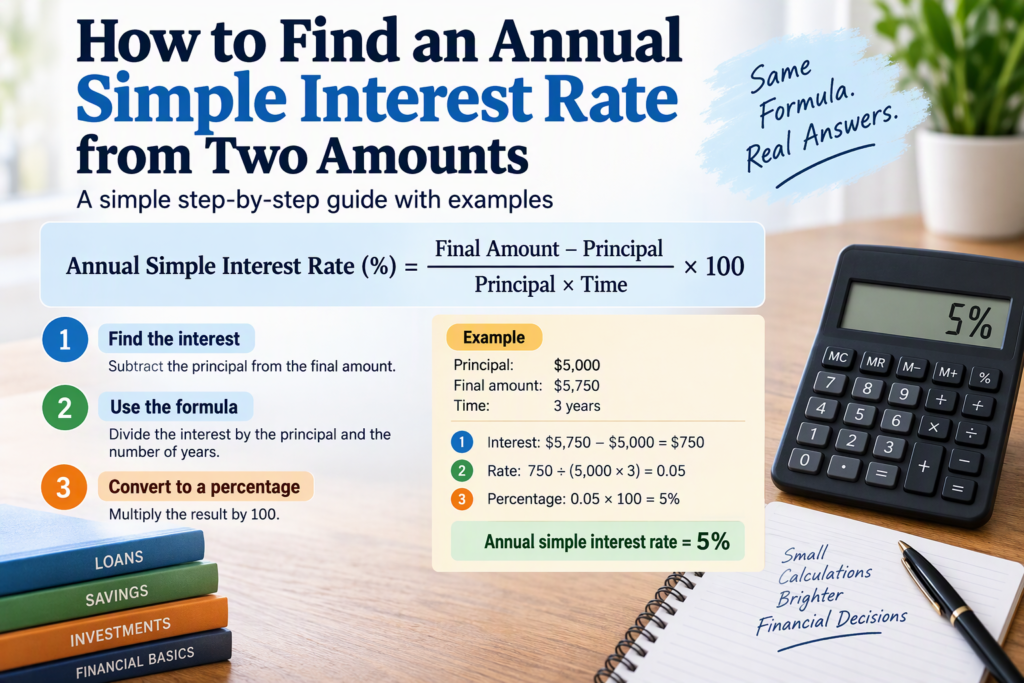
If you know the starting amount (principal), the ending amount, and the time period, you can find the annual simple interest rate using a straightforward formula:
Annual Simple Interest Rate = (Interest ÷ Principal ÷ Time) × 100
First, calculate the interest earned by subtracting the principal from the final amount. Then divide that interest by the principal and the number of years. Finally, multiply by 100 to express the result as a percentage.
This guide explains the process step by step, shows worked examples, and highlights common mistakes so you can confidently calculate annual simple interest rates from two known amounts.
Understanding Simple Interest
Simple interest is interest calculated only on the original principal amount. Unlike compound interest, it does not earn additional interest on previously accumulated interest.
The standard simple interest formula is:
Simple Interest = Principal × Rate × Time
Or:
I = P × R × T
Where:
- I = Interest earned
- P = Principal (initial amount)
- R = Annual interest rate (in decimal form)
- T = Time in years
When you are trying to find the interest rate, you simply rearrange the formula:
R = I ÷ (P × T)
To convert the decimal result into a percentage, multiply by 100.
What Information Do You Need?
To calculate an annual simple interest rate from two amounts, you need:
- The original amount (principal)
- The final amount after interest
- The length of time between the two amounts
Without the time period, it is impossible to determine the annual rate accurately because the same increase could result from different rates over different periods.
Example
Suppose:
- Principal = $5,000
- Final amount = $5,750
- Time = 3 years
You have all the information needed to calculate the annual simple interest rate.
Step-by-Step Method
Step 1: Calculate the Interest Earned
Subtract the principal from the final amount:
Interest = Final Amount − Principal
Using the example:
Interest = $5,750 − $5,000 = $750
Step 2: Use the Simple Interest Formula
Substitute the values into:
R = I ÷ (P × T)
So:
R = 750 ÷ (5,000 × 3)
R = 750 ÷ 15,000
R = 0.05
Step 3: Convert to a Percentage
Multiply by 100:
0.05 × 100 = 5%
Annual Simple Interest Rate = 5%
Formula for Finding the Annual Simple Interest Rate
You can combine the entire process into one formula:
Where:
- Final Amount = Amount at the end
- Principal = Initial amount
- Time = Number of years
This formula works whenever simple interest applies.
Worked Examples
Example 1: One-Year Investment
Given:
- Principal = $2,000
- Final Amount = $2,200
- Time = 1 year
Calculate Interest
$2,200 − $2,000 = $200
Calculate Rate
Convert to Percentage
0.10 × 100 = 10%
Answer: 10% per year
Example 2: Three-Year Loan
Given:
- Principal = $8,000
- Final Amount = $10,160
- Time = 3 years
Calculate Interest
$10,160 − $8,000 = $2,160
Calculate Rate
Convert to Percentage
0.09 × 100 = 9%
Answer: 9% annually
Example 3: Five-Year Savings Account
Given:
- Principal = $12,000
- Final Amount = $15,000
- Time = 5 years
Calculate Interest
$15,000 − $12,000 = $3,000
Calculate Rate
Convert to Percentage
0.05 × 100 = 5%
Answer: 5% per year
Quick Calculation Table
| Principal | Final Amount | Years | Interest | Annual Rate |
|---|---|---|---|---|
| $1,000 | $1,100 | 1 | $100 | 10% |
| $2,500 | $3,000 | 2 | $500 | 10% |
| $4,000 | $4,800 | 4 | $800 | 5% |
| $5,000 | $5,750 | 3 | $750 | 5% |
| $10,000 | $13,000 | 6 | $3,000 | 5% |
Finding the Rate When Time Is Given in Months
Sometimes the time period is provided in months instead of years.
Simple interest rates are normally annual rates, so you must convert months into years first.
Conversion Formula
Example
Suppose:
- Principal = $4,000
- Final Amount = $4,400
- Time = 18 months
Convert Time
18 ÷ 12 = 1.5 years
Calculate Interest
$4,400 − $4,000 = $400
Apply Formula
Convert to Percentage
0.0667 × 100 = 6.67%
Annual Simple Interest Rate = 6.67%
Finding the Rate When Time Is Given in Days
For short-term loans or financial contracts, the period may be expressed in days.
Convert days into years before calculating.
Approximate Conversion
Example
Suppose:
- Principal = $1,500
- Final Amount = $1,560
- Time = 180 days
Calculate Interest
$1,560 − $1,500 = $60
Convert Days to Years
Calculate Rate
Convert to Percentage
Annual Rate ≈ 8.11%
How to Check Your Answer
A simple verification method is to plug your calculated interest rate back into the original simple interest formula.
For example:
- Principal = $5,000
- Rate = 5%
- Time = 3 years
Calculate interest:
Final amount:
Since the result matches the original final amount, the calculation is correct.
Common Mistakes to Avoid
Forgetting to Subtract the Principal
Some people use the final amount as the interest amount.
Incorrect:
Correct:
Always calculate the interest earned first.
Using Months as Whole Years
Treating 18 months as 18 years produces a completely wrong answer.
Correct conversion:
Forgetting to Convert Decimals to Percentages
If your calculation gives:
The rate is:
not 0.07%.
Applying the Formula to Compound Interest
The method in this article only works for simple interest.
If interest is compounded monthly, quarterly, or annually, a different formula is required because interest accumulates on previous interest.
Simple Interest vs Compound Interest
Understanding the difference prevents calculation errors.
| Feature | Simple Interest | Compound Interest |
|---|---|---|
| Interest calculated on | Original principal only | Principal plus accumulated interest |
| Growth pattern | Linear | Exponential |
| Formula | P × R × T | Uses compounding periods |
| Easier rate calculation | Yes | No |
| Common uses | Basic loans and educational examples | Savings, investments, mortgages |
If the problem specifically mentions simple interest, the method in this guide is appropriate.
When Is This Calculation Useful?
Finding an annual simple interest rate can help when:
- Comparing loan offers
- Evaluating borrowing costs
- Checking financial homework answers
- Verifying agreement terms
- Understanding investment returns
- Calculating interest earned on basic savings plans
The calculation is particularly useful when you know the starting and ending amounts but need to determine the rate that produced the change.
Frequently Asked Questions
Can I find the annual interest rate with only the starting and ending amounts?
No. You also need the time period. Without knowing how long it took for the amount to grow, the annual rate cannot be determined.
What if the final amount is smaller than the principal?
That indicates a loss rather than interest earned. The simple interest rate formula would produce a negative result.
Does this formula work for compound interest?
No. Compound interest requires a different formula because interest is earned on accumulated interest over time.
Why must time be in years?
Simple interest rates are usually stated as annual percentages. Converting months or days into years ensures the calculation matches the annual rate.
Can I use a calculator instead of the formula?
Yes. Most financial calculators can determine the interest rate if you enter the principal, final amount, and time period. Understanding the formula, however, helps you verify the result.
Final Thoughts
Finding an annual simple interest rate from two amounts is straightforward once you know the principal, final amount, and time period. Start by calculating the interest earned, divide it by the product of the principal and time, and then convert the result into a percentage.
The key formula is:
Annual Simple Interest Rate = ((Final Amount − Principal) ÷ (Principal × Time)) × 100
With this method, you can quickly determine the annual rate behind a loan, savings account, or investment and check whether financial figures make sense before making important decisions.